A shared starting point
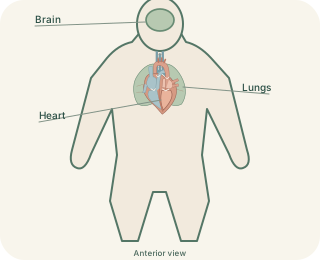
Imagine describing a spot on a map while everybody rotates their map differently. Anatomy avoids that confusion with : standing upright, looking forward, arms beside the body, palms facing forward and feet pointing forward. Descriptions keep this reference even when a person is lying down or bending. Right and left always belong to the person being described, not the viewer. Looking at somebody face to face therefore reverses the right and left sides you see. This convention makes written descriptions useful to different readers.
Anatomical Position and Directional Terms
 Open diagram larger ↗
Words that come in pairs
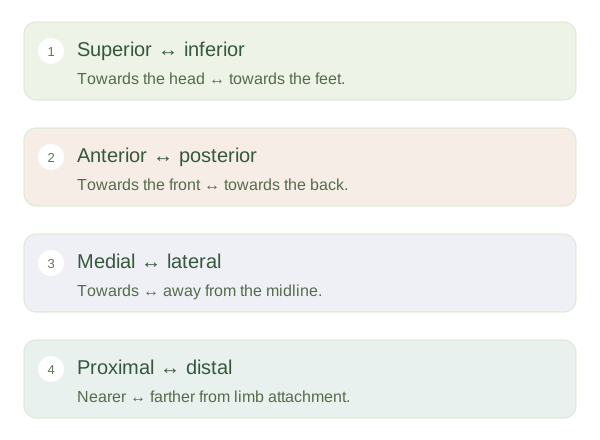
Superior means closer to the head; inferior means closer to the feet. The nose is superior to the mouth. Anterior means towards the front and posterior towards the back: the sternum is anterior to the heart. means nearer the midline; means farther from it. Your little finger is medial to your thumb in . means nearer a limb’s attachment to the trunk, while distal means farther away. The elbow is proximal to the wrist, regardless of how you hold your arm.
Relationships rather than labels
Superficial and deep compare distance from the body surface. Skin is superficial to muscle, but the word superficial does not mean unimportant. These terms are relational: a muscle can be deep to skin yet superficial to a bone. Use a named comparison whenever possible. Saying that a vessel is to a tendon is more informative than calling it medial by itself. Practise describing your own elbow, wrist and fingertips while changing position; their anatomical relationships remain the same even though their height above the floor changes.