Carbohydrates: accessible fuel
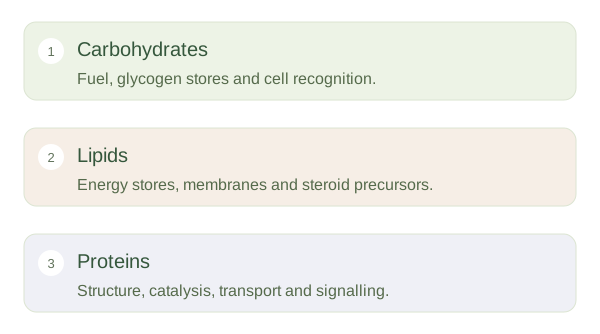
Carbohydrates are molecules built from sugar units. is a small sugar that cells can use in energy-releasing reactions. Joining many glucose units creates , an energy reserve stored mainly in liver and skeletal muscle. Dietary starch is another chain of sugars, whereas fibre contains carbohydrates that human digestive enzymes cannot fully break down. Carbohydrates also attach to proteins and lipids on cell surfaces, helping cells recognise one another. They are therefore more than a category of foods: they are useful chemical building blocks with several distinct roles.
Carbohydrates, Fats and Proteins
 Open diagram larger ↗
Lipids: storage and boundaries
Lipids include fats, phospholipids and steroids. Triglycerides store substantial energy in a compact form and help provide insulation and cushioning. Phospholipids have water-attracting heads and water-avoiding tails. In water they form the basic double layer of cell membranes, creating a boundary that many substances cannot cross freely. Cholesterol helps regulate membrane properties and is a starting material for steroid hormones. These functions explain why labelling all fats as simply harmful is misleading. The body needs lipid molecules, although their distribution and handling can affect health.
Proteins: shape makes function
Proteins are chains of amino acids folded into particular shapes. Some form structural fibres such as collagen; others act as enzymes, receptors, antibodies or transporters. Their shapes determine which molecules they bind and what they do. Heat, unsuitable pH or changes in the sequence can disturb function. Although protein can provide energy, many proteins have specialised jobs that cannot be replaced by sugar or fat. During digestion, large food molecules are broken into smaller components, then cells use those components to build the molecules they need. Eating a protein does not deliver that intact protein directly into your muscles.