A map is a useful average
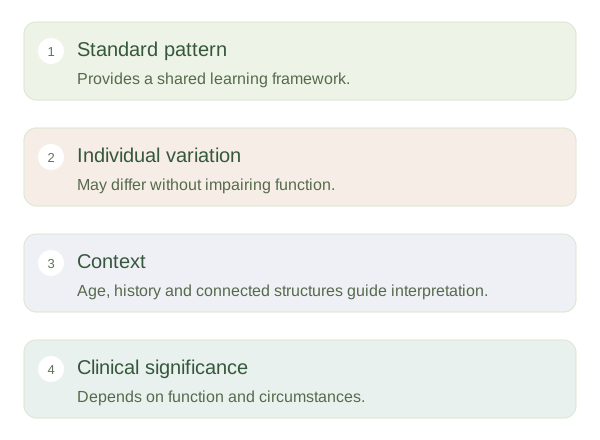
Textbook diagrams show recognisable patterns with unnecessary detail removed. Real bodies have variations in organ size, vessel branching, muscle attachments and other features. Some differences are common enough to be expected; others are uncommon but still compatible with normal function. A diagram is therefore a learning map, not a promise that every body has the exact same arrangement. Even the number of bones can vary because some small bones fuse or occur as accessory structures. Variation is part of biology rather than automatically evidence of disease.
Normal Anatomical Variation
 Open diagram larger ↗
Variation, adaptation and pathology
A variation is a difference from the most commonly described pattern. An is a change related to demands or circumstances, such as increased muscle size with training. concerns harmful structural or functional changes associated with disease. These categories can overlap: a normal branching variant may matter during a procedure, while an adaptation can become harmful under some conditions. Whether a finding matters depends on its function and context, not simply how unusual it looks. Differences related to age, body size and development also need to be considered.
Use patterns without assuming uniformity
Learn the standard arrangement first because it provides a reliable framework for orientation. Then allow for alternatives when applying that knowledge. On medical images, orientation labels and neighbouring structures help prevent a variant from being mistaken for an absent organ or abnormal mass. Clinicians compare findings with symptoms, examination and other evidence rather than diagnosing from one surprising shape alone. Anatomical descriptions also need to reflect the individual being examined. A useful question is not merely “Does this match the picture?” but “What is this structure, how does it connect, and does this arrangement affect function?” That approach preserves the value of textbook patterns while respecting real human diversity.