A joint is a connection
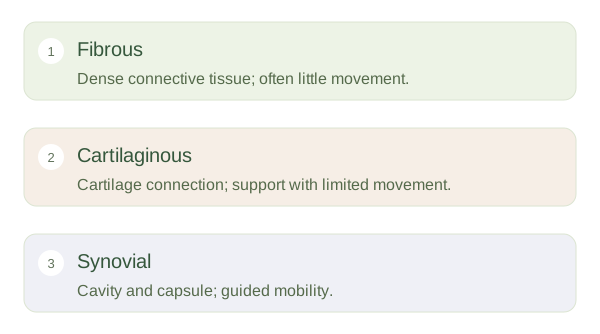
A , or articulation, is where skeletal elements meet. Some permit a wide range of movement; others allow little or none. Structural classification asks what connects the elements and whether a joint cavity exists. Fibrous joints use dense connective tissue. Skull sutures are an example, providing firm connections between neighbouring bones. The attachment of a tooth within its socket is another specialised . These examples show why a joint should not be defined simply as a place where bones move freely.
Types of Joints
 Open diagram larger ↗
Cartilage and cavities
Cartilaginous joints connect elements through cartilage. A developing growth plate is a temporary example involving hyaline cartilage. The pubic symphysis and intervertebral disc connections include fibrocartilage and permit limited movement while resisting loads. Synovial joints have a fluid-containing cavity between articular surfaces and typically permit more movement. Examples include the shoulder, elbow and knee. Their shapes and supporting tissues guide the available motions: a hinge-like arrangement differs from a ball-and-socket arrangement. More possible movement can demand additional muscular control to maintain stability.
Structure and function are related
Functional classification describes how much movement a permits, using categories ranging from essentially immovable to freely movable. This complements structural classification but answers a different question. Joint movement also depends on ligaments, muscles, capsule tension and the tissues surrounding it. A joint is not merely two bone shapes touching. For example, the shoulder’s relatively shallow socket supports mobility, while muscles and soft tissues help keep the head centred. When learning a joint, identify the connecting material, presence of a cavity, surface shape and supporting structures. Together these features explain why a connection is suited to protection, force transfer or wide-ranging movement.