Passive restraints
Ligaments are bands of connective tissue that connect bones and help stabilise joints. Their collagen fibres resist tension, but their mechanical effect depends on fibre direction, joint position and attachment sites. A may become taut in one movement and relatively relaxed in another. It therefore guides motion rather than simply acting as an unchanging rope. Ligaments differ from tendons, which typically transmit muscle force to bone. Both contain organised connective tissue, but the structures they connect and the roles they play are different.
Ligaments, Stability and Joint Injury
 Open diagram larger ↗
Stability has several sources
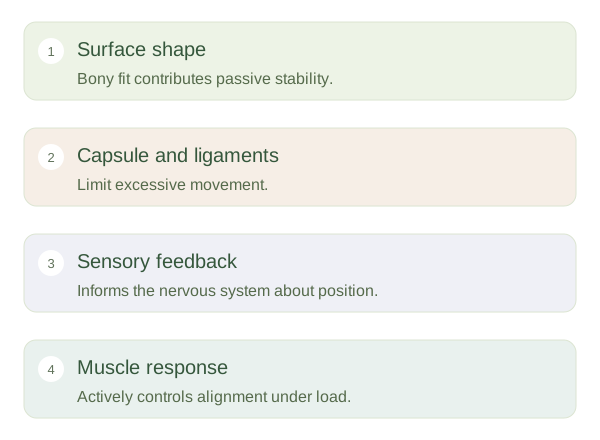
Joint surface shape provides one source of stability. The capsule and ligaments add passive restraint, while muscles and their nervous control provide dynamic stability. Sensory information from tissues around a joint helps the nervous system judge position and adjust muscle activity. This matters when standing on an uneven surface or reaching with a load. A stable joint is not necessarily a rigid joint: good stability means maintaining appropriate alignment during intended movement. The balance differs across the body, with some regions favouring mobility and others strong load transfer.
When restraints are injured
A is an injury to a . Injury severity ranges from microscopic fibre damage to a complete tear. Pain, swelling and altered sensory feedback can affect how surrounding muscles work. A joint may then feel unstable even when several structures remain intact. Conversely, a ligament tear does not mean every movement is uncontrolled, because other restraints can still contribute. A occurs when joint surfaces lose their normal alignment; it is not merely another word for a sprain. Understanding these distinctions helps explain injury mechanisms without reducing the joint to one damaged band. Long-term function depends on the whole supporting system and the demands placed on it.