Injury is not the same as fatigue
A is an injury involving muscle or its tendon, ranging from small fibre disruption to a major tear. Sudden high forces, excessive lengthening or repeated overload can exceed tissue capacity. This differs from fatigue, which is a temporary reduction in performance and does not necessarily involve structural damage. Delayed soreness after unfamiliar activity is also not a precise measure of how much a muscle has grown or how severe an injury is. The location and type of tissue affected matter because muscle and tendon have different structures and repair capacities.
Muscle Injury and Repair
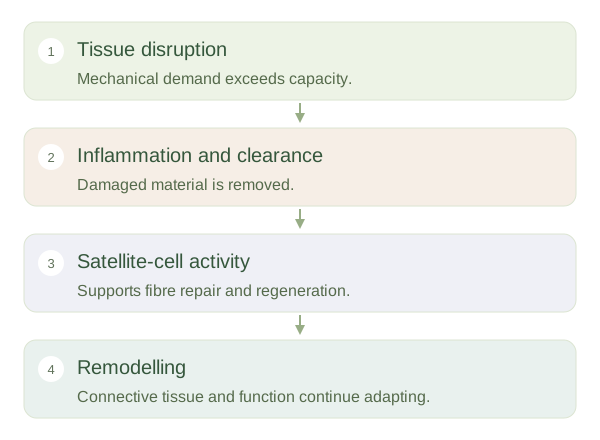 Open diagram larger ↗
The repair response
Damaged muscle triggers inflammatory signals that recruit cells to clear injured material and coordinate repair. Satellite cells, located beside muscle fibres, can become activated, multiply and contribute to repair or . Nearby connective tissue also participates. The result depends on the extent of injury, blood supply, the surrounding matrix and mechanical conditions. Repair does not simply replace every damaged region with an identical new fibre. Larger disruptions may leave , and the organisation of that tissue affects force transmission. Controlled remodelling continues after the earliest inflammation has settled.
A connected system recovers
A muscle’s function depends on nerves, vessels, tendon attachments and nearby joints as well as its contractile cells. Pain can alter movement and recruitment, while reduced use can produce deconditioning. Conversely, repeated excessive loading can disrupt an immature repair. These competing demands explain why recovery is not captured by a single universal timetable. The learning goal is to understand the mechanism rather than to diagnose an injury from soreness alone. Compare a ligament sprain, a muscle and ordinary fatigue: they can all affect movement, but they involve different tissues or processes. Accurate terminology helps connect symptoms to anatomy without assuming they are interchangeable.