Filling the ventricles
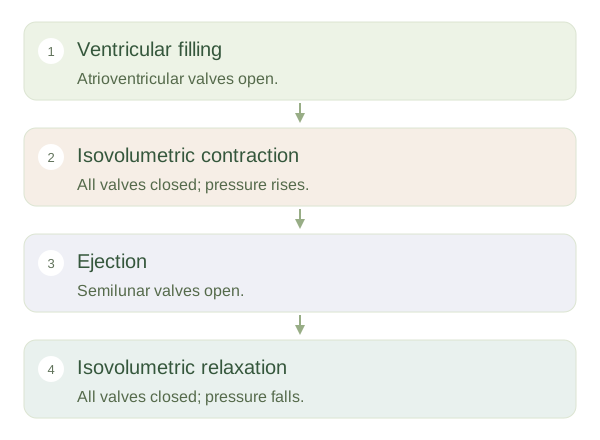
The cardiac cycle is one complete heartbeat, including contraction and relaxation. During much of ventricular , ventricular pressure is low enough for blood to move from atria through open atrioventricular valves. Semilunar valves remain closed because arterial pressure exceeds ventricular pressure. Atrial contraction adds blood near the end of filling, but it is not responsible for all ventricular filling. The volume present just before ventricular contraction is called end-diastolic volume. Filling depends on pressure gradients, chamber relaxation, venous return and the time available.
The Cardiac Cycle
 Open diagram larger ↗
Building pressure and ejecting
As ventricles contract, their pressure rises and the atrioventricular valves close. For a brief interval all valves are closed, so pressure rises without a change in chamber volume; this is contraction. Once ventricular pressure exceeds arterial pressure, the semilunar valves open and blood is ejected. The amount ejected by one ventricle per beat is . A normal ventricle does not empty completely: some blood remains as end-systolic volume. Stroke volume is the difference between end-diastolic and end-systolic volumes, not the total chamber capacity.
Relaxing and starting again
When ventricular muscle relaxes, pressure falls. The semilunar valves close as arterial pressure becomes greater, followed by another short all-valves-closed interval called relaxation. When ventricular pressure falls below atrial pressure, the atrioventricular valves reopen and filling resumes. and therefore describe mechanical phases, while the electrical events that trigger them occur slightly earlier. The two sides follow the same broad sequence but operate at different pressures. Faster heart rates shorten the cycle, especially filling time. Understanding the pressure sequence lets you predict valve position instead of memorising a disconnected list of phases.