Arteries distribute and regulate
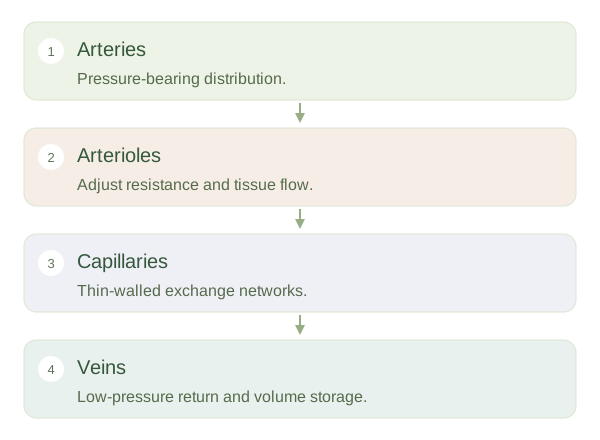
Arteries carry blood away from the heart. Large elastic arteries stretch as blood is ejected and recoil between beats, helping smooth pulsatile flow. Their walls include elastic tissue and smooth muscle within several layers. Smaller muscular arteries distribute blood to regions, while arterioles strongly influence resistance and local flow through changes in smooth-muscle tone. An is defined by direction, not oxygen content: pulmonary arteries carry blood towards the lungs with a lower oxygen content than pulmonary veins. Wall structure reflects pressure and regulation needs.
Arteries, Veins and Capillaries
 Open diagram larger ↗
Capillaries specialise in exchange
Capillaries form tiny networks between the arterial and venous sides of most tissue circulations. Their thin walls, primarily a single endothelial layer and supporting basement membrane, provide short exchange distances. Gases and many small solutes move between blood and tissues, with permeability varying by organ. A brain has tighter barrier properties than a typical liver sinusoid. The large combined cross-sectional area of capillary networks contributes to relatively slow average blood velocity, allowing time for exchange. A capillary is therefore not simply a very small .
Veins return and store
Venules collect blood from capillaries and join into veins. Veins generally have thinner walls and larger lumens than comparable arteries and can hold a substantial fraction of circulating blood. Many limb veins contain valves that reduce backward flow. Skeletal-muscle contraction compresses these veins and assists return towards the heart, while breathing-related pressure changes also contribute. Veins are not passive empty pipes: their smooth muscle and capacity influence distribution of blood volume. The three vessel groups therefore solve different problems within one continuous circuit—pressure delivery, controlled exchange and return—with specialised transitions rather than abrupt changes from one identical tube to another.