Mobile defenders
White blood cells, or leukocytes, are nucleated cells involved in defence, inflammation and immune regulation. They circulate in blood but many perform much of their work after entering tissues. They do not all attack every target in the same way. Different groups respond to different signals and have different abilities to engulf material, release chemicals or coordinate other cells. Blood counts describe the cells present in a sample at that moment; they do not directly measure every immune activity throughout the body. Distribution between blood and tissues changes with circumstances.
White Blood Cells
 Open diagram larger ↗
Rapid responses and specialised signals
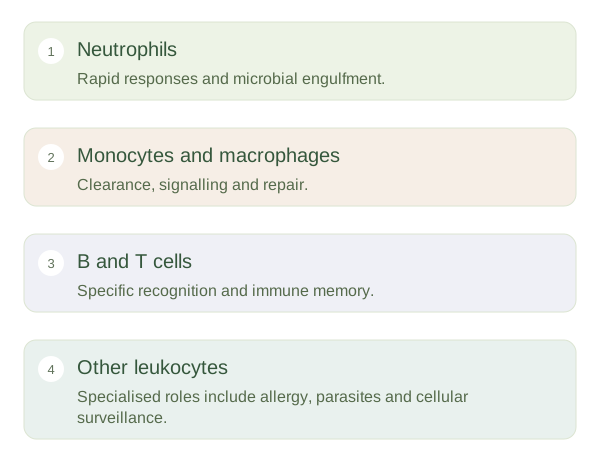
Neutrophils are important early responders to many bacterial infections and tissue injuries. They can engulf microbes and use antimicrobial substances. Monocytes circulate and can enter tissues, where they contribute to populations such as macrophages involved in , signalling and repair. Eosinophils participate in responses to certain parasites and in allergic inflammation. Basophils release mediators involved in allergic and inflammatory responses. These simplified roles overlap, and immune behaviour depends on local signals. A high or low number of one cell type has several possible explanations rather than identifying a specific disease by itself.
Recognition and memory
Lymphocytes include B cells, T cells and natural killer cells. B cells can develop into antibody-secreting plasma cells. T cells perform functions including coordination of immune responses and killing certain infected or abnormal cells. Natural killer cells recognise patterns of cellular stress or altered surface signals. Some B and T cells form long-lived memory populations that respond more effectively to a previously encountered target. Innate and adaptive defences cooperate: early responses help shape later specific immunity, while antibodies and T-cell signals influence other defenders. The most useful model is a coordinated network rather than an army of interchangeable white cells.