A rapid local response
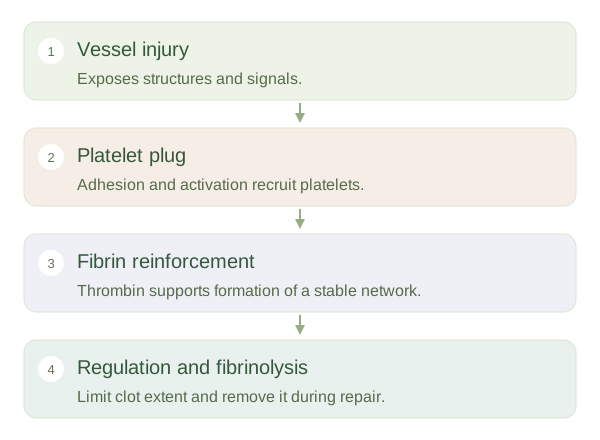
is the process that limits bleeding after vessel injury. The injured vessel can constrict, reducing flow, while platelets respond to exposed structures and local signals. Platelets are small cell fragments produced from large marrow cells called megakaryocytes. They adhere at the injury site, become activated and recruit additional platelets. This forms an initial plug. The response must be localised: a plug is useful at a damaged vessel but can obstruct circulation if it forms inappropriately within an otherwise flowing vessel.
Platelets and Blood Clotting
 Open diagram larger ↗
Fibrin reinforces the plug
Coagulation is a series of interacting protein reactions that generate thrombin. Thrombin converts soluble fibrinogen into , which forms a reinforcing network around the plug. Activated platelets also provide a surface that supports important reactions. The familiar clotting cascade is a learning model; in the body, cells, flow and regulatory mechanisms shape the process. Calcium and several vitamin K-dependent proteins contribute to normal coagulation. Platelets and coagulation are therefore related but distinct parts of , explaining why different defects can produce different bleeding patterns.
Stopping and removing the response
Healthy endothelium and circulating inhibitors help restrict clotting to appropriate locations. As repair progresses, breaks down , mainly through the enzyme plasmin. Clot formation and removal are balanced rather than a permanent instruction to make blood solid. A thrombus is a clot formed within the circulation; an embolus is material travelling through the circulation that can lodge elsewhere. Not every embolus is a blood clot, although clot fragments are an important example. The key distinction is between controlled repair of a vessel leak and unwanted obstruction of a blood pathway. Understanding the sequence links platelets, clotting proteins and vessel-wall health into one coordinated response.