From outside to inside
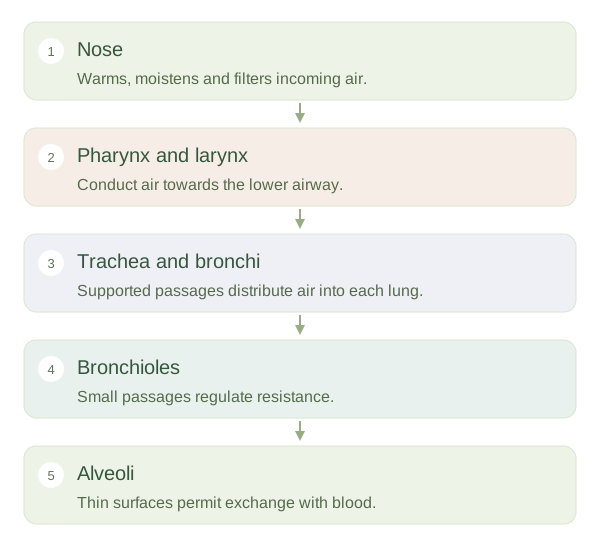
An ordinary breath starts a surprisingly organised journey. Air usually enters through the nose, where hairs and sticky mucus catch larger particles. The curled surfaces inside the nasal cavity increase contact with a warm, moist lining. This helps protect delicate lung tissue from cold, dry air. Breathing through the mouth also delivers air, but bypasses some of this conditioning. Air then passes through the , the shared passage behind the nose and mouth, and through the larynx, which contains the vocal folds.
Airways prepare and deliver air before gas exchange begins.
 Open diagram larger ↗
A branching delivery system
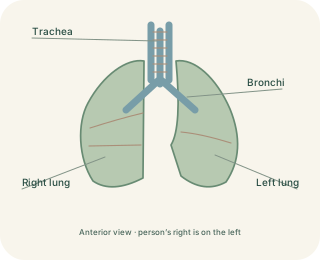
Below the larynx, the trachea carries air towards the chest. Its cartilage supports the airway while allowing movement. The trachea divides into right and left main bronchi, which repeatedly branch into smaller bronchi and bronchioles. Think of an upside-down tree: one trunk supplies an enormous number of fine branches. Bronchioles have smooth muscle that can change their diameter. Narrower passages increase resistance, so more effort is needed to move the same amount of air.
Delivery is different from exchange
Most of this route is the conducting zone. Its walls are too thick for useful exchange of oxygen with blood. Tiny moving hairs called sweep trapped material towards the throat, helping clear the airway. Farther along, respiratory bronchioles lead to alveolar ducts and alveoli, where gas exchange becomes possible. Air remaining in conducting passages is called anatomical dead-space air. It is not useless: these passages deliver and protect the next breath. However, a rapid series of very shallow breaths may move considerable air without bringing much fresh air to the alveoli. Effective breathing therefore depends on both airway openness and enough depth to reach the exchange surfaces.