A quick response can begin locally
Touching something painfully hot can trigger withdrawal before you have fully identified what happened. A sensory receptor detects the stimulus, and a sensory neuron carries information into the spinal cord. Local circuits activate motor neurons serving appropriate muscles. This pathway is a . It allows a useful response without waiting for a detailed conscious decision. Information also travels towards the brain, so rapid withdrawal does not mean the brain is uninformed.
Reflexes provide fast responses while brain networks shape purposeful movement.
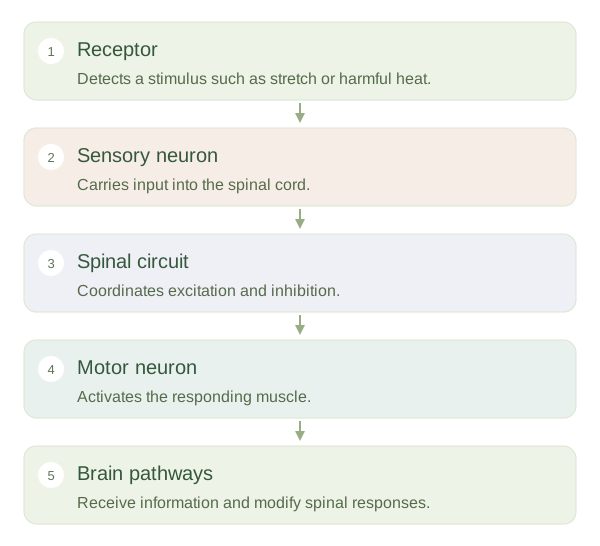 Open diagram larger ↗
Reflexes are organised, not random
A stretch helps resist unexpected muscle lengthening. The muscle spindle detects stretch, and sensory input influences motor neurons supplying the same muscle. Coordinated inhibition of opposing muscles can allow the intended response to occur more effectively. Other reflexes involve several interneurons and multiple muscles. For example, withdrawing one leg may be accompanied by adjustments in the other leg to maintain support. Different reflexes therefore have different complexity and timing.
Deliberate movement uses the same final machinery
Choosing to reach for a cup involves planning in cortical networks, coordination with basal nuclei and cerebellum, and descending signals to spinal circuits. Motor neurons then activate skeletal muscle fibres. These lower motor neurons are a shared final output route for both and voluntary influences. The brain can increase or suppress aspects of reflex activity according to context. A reflex is therefore not necessarily an unchangeable response, and voluntary movement is not a single command travelling without feedback. Sensory information continually reports limb position, muscle length and contact with objects. Smooth movement emerges from cooperation between goals, ongoing feedback and spinal circuitry. This explains why examining reflexes can reveal information about both local circuits and descending control, rather than testing muscle strength alone.