The brain changes state rather than switching off
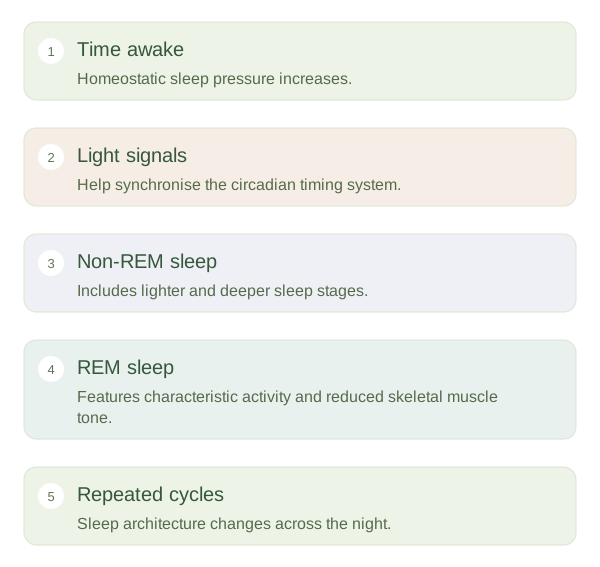
Sleep is a reversible state of reduced responsiveness with organised changes in brain activity. It alternates between non-rapid-eye-movement sleep and rapid-eye-movement, or REM, sleep. includes lighter and deeper stages. often involves vivid dreaming and reduced activity in many skeletal muscles. These states recur in cycles through the night, but their proportions change across the night and across life. Sleep is therefore not one uniform period of brain inactivity.
Sleep is an active, regulated state shaped by timing and sleep pressure.
 Open diagram larger ↗
Two influences help set the schedule
Homeostatic generally increases with time awake and decreases with sleep. A circadian timing system also influences when the body promotes sleep or wakefulness. The suprachiasmatic nucleus in the hypothalamus receives light-related information and helps coordinate daily rhythms. Melatonin signals biological night, but it is not an instant switch that explains every aspect of sleep. Timing, previous sleep, light exposure and individual biology interact to influence readiness for sleep.
Rest supports an active body
Sleep contributes to attention, learning, memory, immune regulation and many other functions. Brain networks continue working, and changes in breathing, heart rate and hormones depend partly on the stage. Lack of sleep can impair performance even when a person feels they have adapted to being tired. The amount and timing of sleep needed vary with age and individual circumstances, so one universal number is not appropriate for every learner. Dreams can occur in more than one stage, and REM is not the only valuable part of sleep. Understanding the system helps replace the idea of sleep as wasted time with a more accurate picture: it is a coordinated biological activity that supports effective wakefulness and reflects interactions between brain circuits, environmental timing and the body’s recent history.