One organ, different output routes
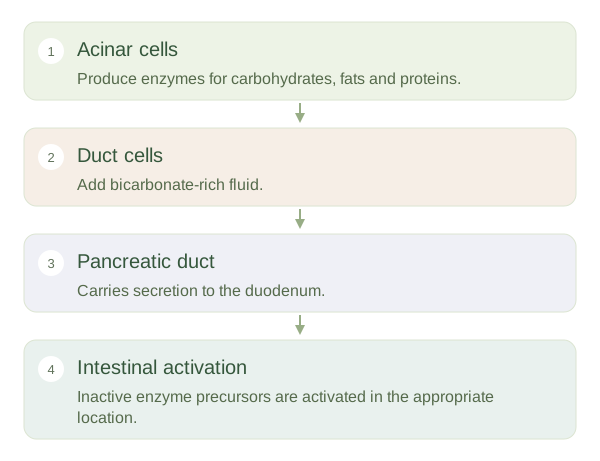
The pancreas has both and endocrine functions. Exocrine acinar cells make digestive enzymes that travel through ducts into the duodenum, the first part of the small intestine. Endocrine cells release hormones such as insulin into blood. These routes serve different purposes, even though they occur in the same organ. Insulin does not travel down the pancreatic duct to digest a meal, and digestive enzymes are not normally released into the circulation to perform their usual job.
The exocrine pancreas supplies enzymes and bicarbonate to the small intestine.
 Open diagram larger ↗
A toolkit for several nutrients
Pancreatic amylase breaks down starch into smaller carbohydrates. Lipase helps break dietary triglycerides into products that can be absorbed. Proteases break proteins into smaller fragments. Many protein-digesting enzymes are released as inactive precursors and are activated after reaching the intestine. For example, intestinal enteropeptidase starts conversion of trypsinogen to trypsin; trypsin then helps activate other precursors. This sequence helps keep strong protein-digesting activity away from the pancreatic tissue that makes it.
The environment matters too
Duct cells add bicarbonate-rich fluid, helping neutralise acidic chyme arriving from the stomach. Enzymes work best within suitable chemical conditions, so neutralisation supports digestion and protects the intestinal lining. Hormonal signals coordinate delivery: secretin promotes bicarbonate-rich secretion, while cholecystokinin helps stimulate enzyme secretion and gallbladder contraction. Neural influences also contribute. If pancreatic secretion is substantially reduced, nutrient digestion can be impaired even if food moves through an anatomically open intestine. Fat digestion is often particularly affected. The key idea is partnership: the stomach prepares food, bile helps handle fat, and pancreatic secretions supply much of the chemical toolkit used in the small intestine. No single digestive organ completes the entire process by itself.