Acidity must remain controlled
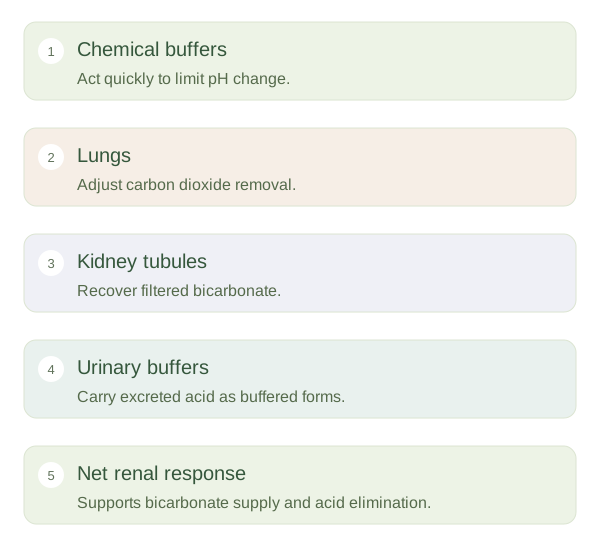
Normal cellular activity produces acids and acid-related chemical loads. Large shifts in blood pH can disrupt protein function and electrical activity. Chemical buffers act quickly to limit changes, but they do not permanently remove every added acid. The lungs regulate carbon dioxide removal, which influences the buffer system. The kidneys provide another essential route by adjusting bicarbonate handling and excreting acid. These mechanisms cooperate at different speeds rather than competing to perform one identical task.
Kidneys conserve bicarbonate and excrete acid to support stable blood pH.
 Open diagram larger ↗
Recovering a valuable buffer
is filtered at the glomerulus, but much is normally reclaimed through tubular processes. Hydrogen secretion into tubular fluid helps convert filtered bicarbonate into forms that allow its components to return across cell membranes. This recovers existing buffer rather than simply creating an unlimited new supply. Different nephron segments contribute, and downstream intercalated cells can make fine adjustments. If useful bicarbonate were continually lost in large amounts, the body’s capacity to handle acid would fall.
Adding new buffer while excreting acid
The kidneys can also generate that returns to blood while acid is excreted with urinary buffers such as phosphate or as . Binding hydrogen ions to these substances allows more acid elimination than would be possible by excreting only freely dissolved hydrogen ions. Renal adaptation generally takes longer than respiratory changes, often developing over hours to days. Kidney impairment can therefore contribute to even when breathing increases to compensate. Urine pH alone does not describe the whole body’s acid–base status, because buffering and ammonium handling also matter. The central lesson is coordinated chemistry: buffers limit immediate change, lungs regulate carbon dioxide and kidneys maintain bicarbonate and net acid balance.