Messages carried by blood
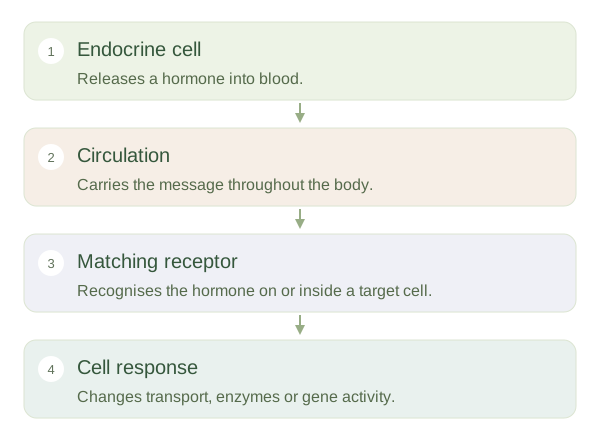
A is a chemical message released by endocrine cells into the blood. Circulation distributes that message widely, allowing distant tissues to coordinate their activity. Insulin, for example, helps organise the handling of nutrients after a meal. A hormone does not need a separate blood vessel leading to each destination: blood carries many messages at once, and individual cells select which ones they can recognise.
From gland to target
 Open diagram larger ↗
A receptor makes a target
A contains a that binds a particular . Think of a receptor as a message reader rather than an open doorway. Binding changes activity inside the cell, perhaps adjusting an enzyme, moving transport proteins or altering which genes are used. The same hormone can produce different effects in different tissues because their receptors and internal machinery differ. Adrenaline increases heart activity while changing blood flow through selected vessels.
Different routes to a response
Many water-soluble hormones, including peptide hormones, bind receptors on the cell surface because they cannot readily cross the fatty cell membrane. Their signals are passed inward through chemical relay systems. Steroid hormones usually cross the membrane and bind receptors inside the cell, often changing protein production. These differences help explain why some hormonal effects appear rapidly while others develop more slowly. Thyroid hormones also act through intracellular receptors, although they are not steroids.
Sensitivity can change
The effect of a depends on its concentration, numbers and the condition of the . Persistent exposure can change receptor availability or downstream responses. In insulin resistance, cells respond less effectively to insulin; the hormone is not simply absent. Hormonal communication therefore depends on both a sender and a responsive receiver, with signals continually adjusted to the body's needs.