An internal daily rhythm
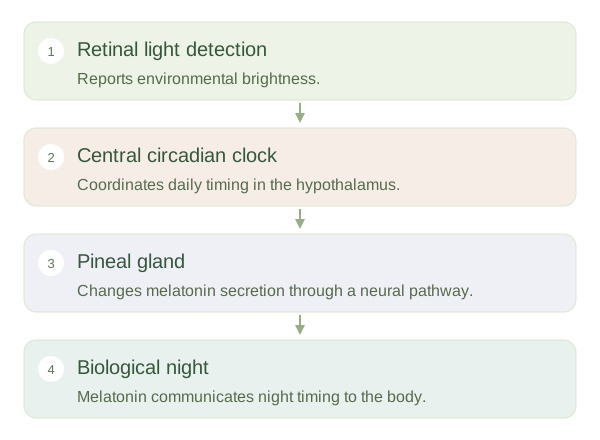
Many body functions vary across roughly twenty-four hours, including alertness, temperature and hormone secretion. These circadian rhythms are generated by biological clocks rather than being simple reactions to each moment of daylight. A central clock in the of the hypothalamus helps coordinate clocks elsewhere in the body. Without timing cues, internal rhythms can drift away from the external day.
From environmental light to night timing
 Open diagram larger ↗
Light sets the clock
Special light-sensitive retinal cells send information to the central clock. This pathway mainly signals environmental brightness rather than forming the detailed images used for vision. Light timing is important: light exposure at different biological times can shift the clock in different directions. Meals, activity and social schedules also influence daily patterns, but light is a particularly powerful cue for coordinating the central rhythm with day and night.
The pineal night signal
The pineal gland releases under control of a neural pathway linked to the circadian clock. Levels usually rise during biological night and are suppressed by light. Melatonin therefore helps communicate the timing of darkness to the body. It is not an anaesthetic or the only cause of sleep. Sleep also depends on a homeostatic drive that generally builds during wakefulness and declines during sleep, as well as many interacting brain systems.
When clocks and schedules differ
Jet lag occurs when internal timing no longer matches a new local light–dark schedule. Shift work can create a similar mismatch between work demands and biological night. These examples show why being tired does not always make falling asleep easy: and circadian alerting signals can point in different directions. Individual timing varies with age and other factors. This explains the physiology of daily rhythms without implying that every sleep difficulty has one hormonal cause or requires a hormone supplement.