Restarting a signalling network
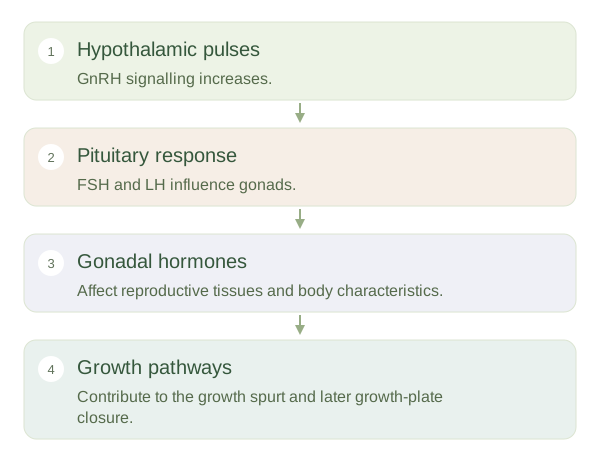
is the period when reproductive systems mature and characteristic adolescent body changes develop. Increasing pulsatile release of gonadotropin-releasing hormone, , from the hypothalamus stimulates pituitary FSH and LH release. These hormones influence the gonads, increasing sex-steroid production and reproductive-cell development. The network was present earlier in life; puberty reflects changes in its activity rather than the sudden appearance of entirely new organs.
Hormonal coordination of puberty
 Open diagram larger ↗
Different tissues respond
Oestrogens, testosterone and other hormones act on many targets. Changes can include breast development, genital growth, altered body composition, voice changes and maturation of the reproductive tract. Adrenal androgen production also increases around this developmental period and contributes to pubic and underarm hair. Growth hormone and related growth factors support the adolescent growth spurt. Sex steroids later contribute to closure of growth plates, helping explain why rapid growth is followed by slowing in height gain.
Reproductive milestones
In ovarian development, is the first menstrual period. Early cycles may be irregular and may not consistently involve ovulation. In testicular development, sperm production begins as supporting and germ cells mature under hormonal control. A single visible milestone does not mean every physical or psychological aspect of development is complete. Fertility potential, emotional development and social readiness are different matters, and an individual's experience cannot be inferred from body appearance alone.
Variation is expected
The age, pace and order of changes vary, influenced by genetics, nutrition, health and other factors. People with variations in sex development or receiving hormone-related care may follow different patterns. is therefore best understood as a coordinated process with a range of normal timings, not a competition or a fixed calendar. Clinicians consider the overall pattern and context when deciding whether a developmental change needs assessment, rather than relying on comparison with one peer or illustration.