Keeping microbes outside
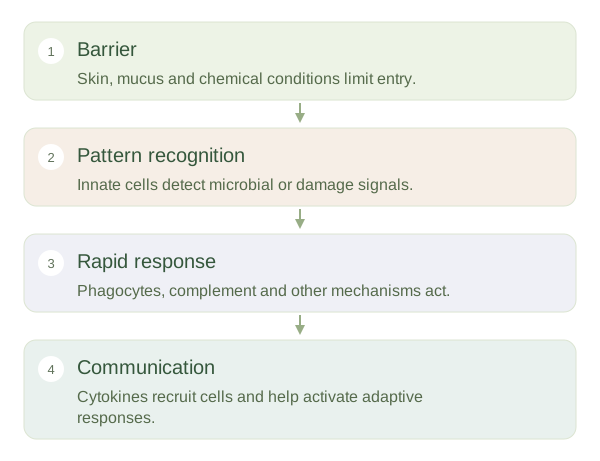
The body meets microbes constantly, but contact does not always become infection. Intact skin provides a physical barrier, while mucus on internal surfaces traps particles and organisms. Cilia in airways help move trapped material towards removal. Chemical conditions, including stomach acidity and antimicrobial substances in secretions, can make survival difficult for some microbes. Normal resident microbes can also compete with potential pathogens. No barrier is absolute, but several overlapping defences reduce entry.
Layers of early defence
 Open diagram larger ↗
Recognising a problem quickly
When microbes cross a barrier, innate immune cells can recognise common molecular patterns associated with microbes or damaged tissue. Their receptors are not tailored through a new learning process for each individual exposure. Macrophages and neutrophils can engulf material through . Dendritic cells help connect early recognition with later adaptive responses by presenting antigen to lymphocytes. is therefore fast and broadly patterned, not completely blind or unselective.
Signals and supporting proteins
Innate cells release cytokines that alter nearby and distant cell behaviour. These signals can recruit more immune cells and promote inflammation. Complement proteins in blood can coat microbes, amplify inflammatory signals and, in some cases, damage microbial membranes. Natural killer cells can destroy selected abnormal or infected cells. Interferons help establish antiviral responses in neighbouring cells. These mechanisms overlap and cooperate rather than waiting in a strict queue.
Connecting to adaptive defence
Adaptive immunity uses highly specific lymphocyte receptors and can generate long-lasting memory. Innate responses help activate and guide that system while limiting early spread. A useful comparison is a layered security system: barriers restrict entry, rapid sensors trigger action, and specialised teams then develop a targeted response. The analogy has limits, because immune cells communicate continuously and can also cause tissue damage if regulation fails. Defence must control threats while limiting harm to the body itself.