Closing the immediate gap
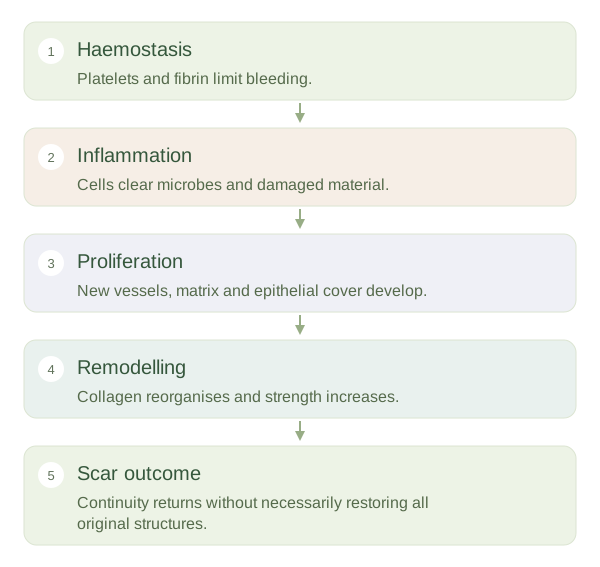
When an injury disrupts skin and vessels, limits blood loss. Platelets adhere and become activated, while coagulation produces a network that stabilises the clot. The clot also provides a temporary framework for repair. The depth of injury matters: damage confined to the epidermis may be repaired differently from damage that destroys dermis, follicles and other structures. Healing is not simply the surface drying out.
Overlapping stages of repair
 Open diagram larger ↗
Inflammation and cleanup
In the inflammatory phase, recruited white cells help control microbes and remove damaged material. Neutrophils often arrive early, followed by monocytes that can become macrophages. Macrophages also release signals influencing new vessel growth and fibroblast activity. Some inflammation is part of normal repair, but persistent infection or excessive inflammation can delay healing. These phases overlap rather than following an exact timetable identical for every wound.
Building a replacement
During the proliferative phase, new capillaries and connective tissue form . Fibroblasts deposit extracellular matrix, including collagen, while epithelial cells migrate and divide to cover the surface. Some wounds also contract through the activity of specialised contractile cells. Hair follicles and other surviving skin structures can provide sources of epithelial cells. A deep injury that destroys these sources has less capacity to restore the original architecture than a superficial injury with many structures preserved.
Remodelling and the scar
Over time, collagen is reorganised and the repair gains strength. It generally does not recover every feature or the full mechanical strength of uninjured skin. A contains altered connective tissue and may lack normal appendages. Blood supply, nutrition, diabetes, mechanical stress and several other factors influence repair. The lesson is structural: closing a wound and recreating the original tissue are different achievements. This overview explains why healing needs coordinated circulation, immune activity and cell growth without prescribing treatment for an individual injury.