Balance uses several sources
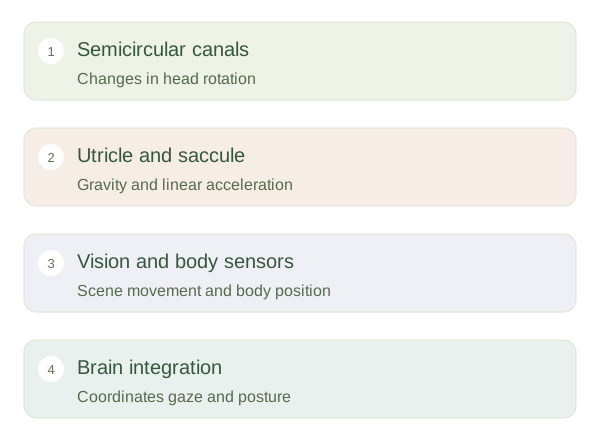
The vestibular organs lie in the inner ear beside the cochlea. They provide information about head movement and orientation, helping keep vision steady and posture appropriate. Balance also depends on vision and signals from muscles, joints and skin. The brain combines these sources rather than relying on one tiny balancing point. This explains why standing on an uneven surface with your eyes closed can be harder: useful visual information has been removed, while information from your feet is also less dependable.
Three information sources for balance
 Open diagram larger ↗
Rotation versus straight-line movement
Three semicircular canals are arranged in different planes. During head rotation, inertia creates relative fluid movement that bends sensory hair-cell projections through a gelatinous structure called the cupula. These receptors are especially useful for detecting changes in rotational motion. The utricle and saccule contain sensory patches with small calcium-carbonate particles called . Their weight and inertia shift a covering layer, signalling head tilt relative to gravity and linear acceleration. A lift starting to rise and a quick head turn therefore stimulate overlapping but distinct vestibular sensors.
Keeping your gaze steady
When you turn your head, the moves the eyes in the opposite direction, helping maintain a clear image on the retina. Other connections influence trunk and limb muscles to support posture. Matching signals from the two ears, vision and body sensors normally fit together. When these inputs disagree, as during some forms of travel, motion sickness may occur. Persistent spinning sensations can arise from several different mechanisms and are not explained simply by having poor balance. The useful principle is that balance is a coordinated estimate of movement, continuously updated using multiple sources.