Chemicals reaching receptors
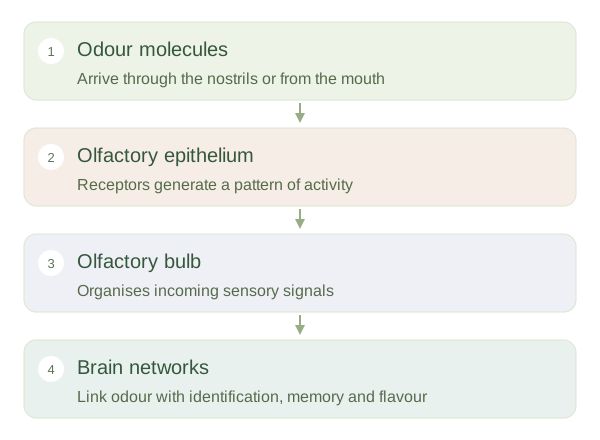
Smell, or , begins when molecules enter the nose and dissolve in mucus near the high in the nasal cavity. This small sensory region contains neurons with receptor-bearing projections. Most odours contain several chemicals, and each chemical can activate more than one receptor type. The brain recognises a combined activity pattern rather than relying on a separate labelled neuron for every possible smell. Nasal airflow matters because molecules must actually reach this sensory surface to be detected.
Two routes to the same smell receptors
 Open diagram larger ↗
A short route into brain networks
Olfactory neurons send fine axons through openings in the cribriform plate to the olfactory bulbs. There, signals converge in organised groups before travelling to several brain regions involved in identification, emotion and memory. Early olfactory processing reaches cortical areas without first passing through the usual thalamic relay used by many other senses. Later processing does involve wider networks, including the thalamus. This arrangement helps explain the close connections between smells and memories, without implying that every smell response is automatic or emotionally meaningful.
Smell is part of eating
During chewing, volatile molecules can travel from the mouth towards the nose through the back of the throat. This contributes strongly to flavour. A blocked nose can therefore make foods seem bland even when basic taste sensations remain. Chilli heat and the sharpness of some chemicals also involve trigeminal sensory pathways, rather than smell receptors alone. Smell perception often fades during continuous exposure, helping new odours stand out. Olfactory neurons can be replaced, but this capacity does not guarantee recovery after every injury or disease. Flavour is a combined perception, not just the tongue reporting five tastes.