A chemical sampling system
Taste, or , helps assess substances entering the mouth. Dissolved molecules reach receptor cells grouped in taste buds. Many taste buds sit within particular tongue papillae, while others occur elsewhere in the mouth and throat. Not every visible tongue bump contains taste buds. The five well-established basic taste qualities are sweet, sour, salty, bitter and . Umami is the savoury quality associated with substances such as glutamate. These qualities provide information, but pleasant taste alone cannot prove that something is nutritious or safe.
From food chemistry to flavour
 Open diagram larger ↗
How a taste signal travels
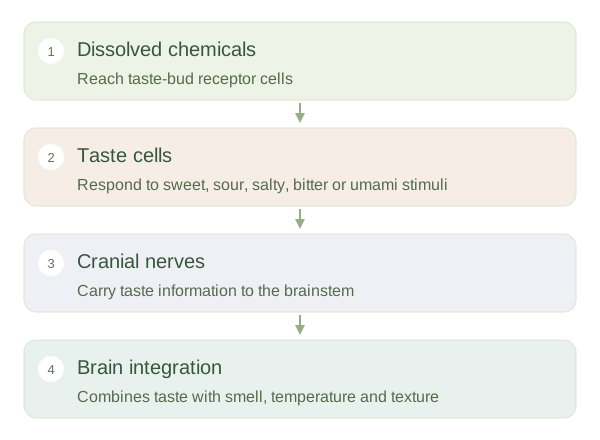
Different taste cells use different mechanisms to respond to chemicals. Some detect ions more directly, while others use receptor proteins that start internal signalling pathways. Activated cells communicate with sensory nerve fibres. Taste from the mouth travels mainly through branches of the facial, glossopharyngeal and vagus nerves, reaching the brainstem and then higher processing centres. The familiar map assigning sweet only to the tongue tip and bitter only to the back is misleading. Sensitivity varies, but multiple basic tastes can be detected across many taste-bearing areas.
Flavour adds more information
What we call flavour combines taste with smell, temperature, texture and chemical irritation. Crispness and creaminess are not additional basic tastes; they are features of this richer sensory experience. Chilli activates heat-sensitive pain-related pathways, while menthol stimulates cool-sensitive pathways. Neither requires the food to have the corresponding physical temperature. Taste can influence salivation and digestive preparation, and experience shapes food preferences. The key distinction is useful when a meal seems different: losing smell may reduce flavour complexity while leaving sweet or salty sensations detectable. The tongue samples chemistry, but the brain builds the overall eating experience.