Mobility with a stable base
The neck must position the eyes and ears while supporting the weight of the head. Movement occurs across several cervical joints, so a turn or nod is a combined action rather than one muscle moving one hinge. Deep muscles provide close control near the vertebrae, while larger superficial muscles generate broader movements. brings the chin towards the chest, extension tips the head backwards, tilts it sideways and rotation turns it. Normal tasks combine these actions in different proportions.
Neck muscle groups and their roles
 Open diagram larger ↗
Recognisable muscle groups
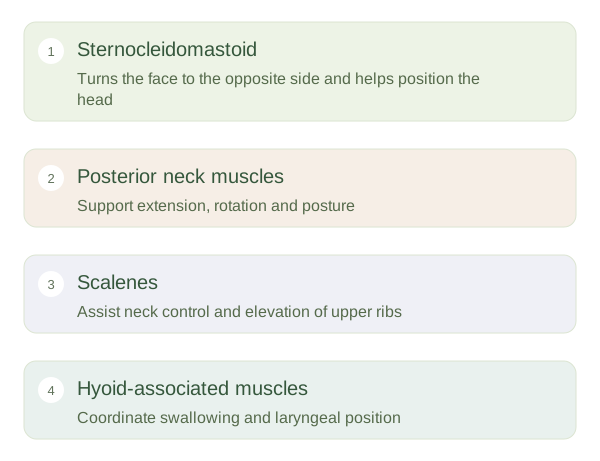
runs from the sternum and clavicle towards the mastoid region behind the ear. Acting mainly on one side, it turns the face towards the opposite side and tilts the neck towards its own side. The effect of both muscles together depends partly on head position, contributing to lower-neck and upper-head extension. Posterior muscles, including splenius and deeper groups, help extend and rotate the head. The scalenes connect cervical vertebrae to the upper ribs and contribute to side bending, stability and assisted inspiration when demand rises.
Movement depends on coordination
Muscles above and below the position the hyoid and larynx during swallowing and speech. They are not simply extra head-turning muscles. The trapezius links the neck with the shoulder girdle, so shoulder position also influences how the head is supported. During a controlled movement, opposing muscles can remain partly active to provide stability and limit unwanted motion. This is why muscle function cannot be reduced to a list of isolated actions. Nerves, sensory feedback, joints and coordinated muscle activity together determine whether movement is smooth, stable and appropriately directed.