Curves viewed from the side
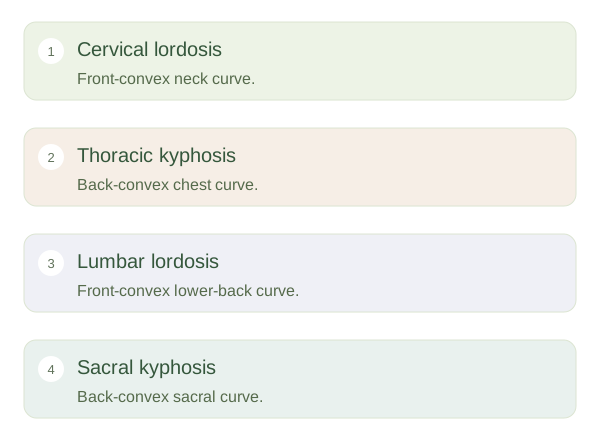
A normal adult spine is not straight when viewed from the side. The cervical and lumbar curves are convex towards the front; the thoracic and sacral curves are convex towards the back. These alternating curves help place the head over the trunk and the trunk over the pelvis. They also contribute to distributing mechanical loads. From behind, the spine is normally approximately centred rather than following the same alternating sideways pattern. Therefore a sideways curve and the usual front-to-back curves describe different anatomical features.
Spinal Curves and Movement — concept map
 Open diagram larger ↗
Movement differs by region
bends the trunk forwards, extension moves it backwards, lateral flexion bends sideways, and rotation turns it. Each spinal segment allows only a limited amount of movement, determined by disc properties, facet-joint orientation and surrounding tissues. The neck permits extensive movement to position the head. The rib cage restricts some thoracic movement but does not make the chest completely rigid. The lumbar region allows substantial flexion and extension, with more limited rotation. Hip movement also contributes when a person bends forward; the visible movement of the trunk is not produced by the lumbar spine alone.
Balance is dynamic
Maintaining balance means continually adjusting muscle activity around these curves. A comfortable posture changes with the task, the person and the duration of holding it. There is no single rigid position that every healthy back must maintain all day. A change in a curve can alter how loads are shared, but appearance alone does not establish a diagnosis. The terms and describe the direction of curvature and can also be used clinically when a curve is excessive. Understanding the normal pattern first helps you distinguish ordinary anatomy from a claim that every visible curve is abnormal.