The socket moves with its base
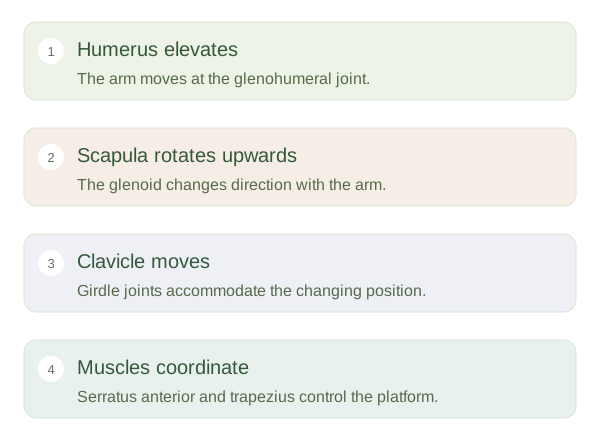
The glenoid socket belongs to the scapula, so moving the scapula changes the direction in which the socket faces. During a reach above the head, the humerus elevates while the scapula rotates upwards and changes its tilt. The clavicle also moves at its joints. This coordinated pattern is called . It is sometimes simplified to a fixed ratio, but the actual contribution changes with the stage of movement, load and individual. The useful idea is shared motion, not a rule that every degree of movement must occur in an identical proportion.
Scapular Movement and Shoulder Stability — concept map
 Open diagram larger ↗
Muscles control the platform
attaches to the ribs and the medial border of the scapula. It helps hold the scapula against the chest wall and contributes to upward rotation. Trapezius has upper, middle and lower parts whose combined actions position and rotate the scapula. Rhomboids and other muscles contribute to retraction and control. These forces must be coordinated rather than simply maximised. A scapula that cannot rotate appropriately may restrict how the hand reaches, even when the glenohumeral joint itself can move. Conversely, arm position changes what scapular muscles need to do.
Stability during real tasks
When pushing a door, hanging from a bar or carrying a bag, the shoulder complex faces different force directions. Some muscles move the scapula while others hold it relatively steady as a base for humeral movement. Injury to the long thoracic nerve can weaken , allowing the medial scapular border to stand away from the chest; this is one form of winging. Visible winging has more than one possible cause, so appearance alone does not locate a lesion. Shoulder stability therefore includes both keeping the humeral head controlled and positioning the entire scapula. The joint and its supporting platform must work together.