Two sources of muscle force
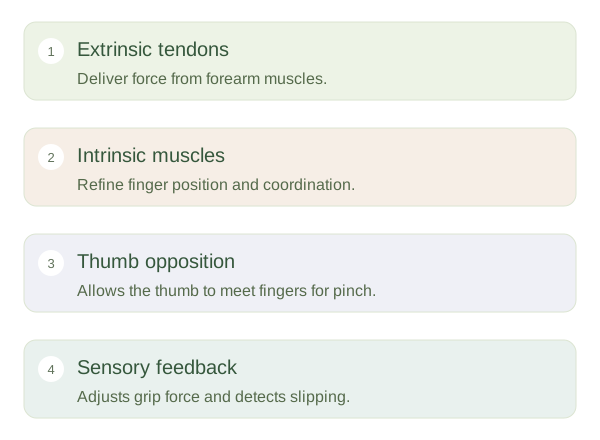
Extrinsic hand muscles have their bellies in the forearm and transmit force through long tendons. Intrinsic muscles begin and end within the hand. Both are needed for useful grip. Long flexors generate much of the force for closing the fingers, while small intrinsic muscles refine joint position. The thenar group forms the prominence at the base of the thumb, and the hypothenar group lies on the little-finger side. Interossei lie between metacarpals, while lumbricals arise from finger-flexor tendons. Their compact arrangement allows fine control without making the fingers bulky.
Hand Muscles, Tendons and Grip — concept map
 Open diagram larger ↗
The thumb changes the possibilities
brings the thumb across the palm towards the fingertips. This combines movement at the thumb’s saddle-shaped carpometacarpal joint with rotation and adjustments at other joints. It makes precision pinch possible, as when picking up a coin. A power grip, such as holding a handle, uses flexed fingers and a thumb positioned to secure the object. The wrist also needs a stable position. Sensation helps estimate force and detect slipping, allowing the nervous system to adjust grip without crushing a fragile object or dropping it.
Tendons distribute coordinated force
Finger extension is not produced by one tendon acting on one simple hinge. Extensor expansions spread tendon forces across the backs of the fingers and receive contributions from intrinsic muscles. Lumbricals and interossei can flex the knuckle joints while helping extend the interphalangeal joints. This combination permits controlled finger shapes rather than only an all-open or all-closed hand. The ulnar nerve supplies most intrinsic hand muscles, while the median nerve supplies important thenar muscles and the lateral two lumbricals. The pattern illustrates how precise movement depends on several nerves and a linked tendon network, not merely on strong finger flexors.