Five useful pathways
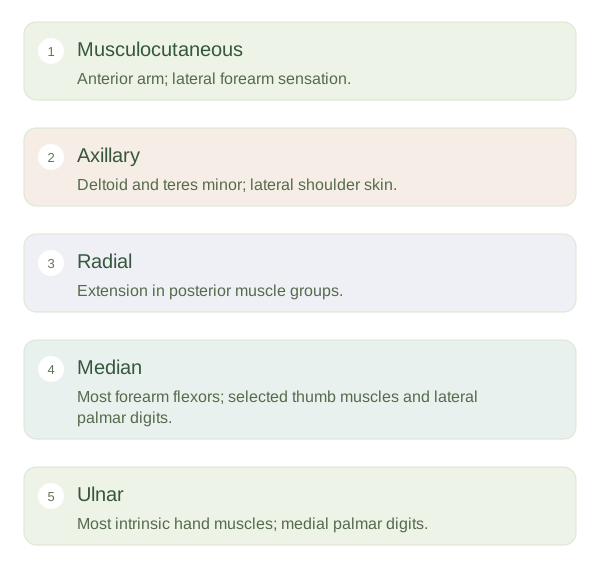
The musculocutaneous, axillary, radial, median and ulnar nerves are major terminal branches of the brachial plexus. Musculocutaneous supplies most anterior arm muscles and continues with sensation over the lateral forearm. Axillary supplies the deltoid and teres minor and sensation over a small lateral shoulder area. Radial supplies the posterior arm and forearm muscle groups, making it important for elbow, wrist and finger extension. These associations connect a named pathway with a set of actions rather than one isolated muscle. Each nerve also gives branches at several points along its route.
Major Upper-Limb Nerves and Their Territories — concept map
 Open diagram larger ↗
Median and ulnar contributions
The median nerve supplies most anterior forearm muscles and important thumb muscles in the hand. Its hand sensory territory includes much of the palmar thumb, index, middle and lateral half of the ring finger. The supplies flexor carpi ulnaris, part of the deep finger flexor and most intrinsic hand muscles. Its sensory territory includes the little finger and medial half of the ring finger. Thumb movement is not supplied by the median nerve alone: some thumb actions depend on ulnar or radial pathways. Functional tasks therefore combine several nerves.
Level matters as much as name
A injury above the elbow may affect functions that would be spared by a distal branch injury. The same principle applies to median and ulnar nerves. Sensory territories overlap and vary, while spinal roots distribute fibres through more than one peripheral nerve. Clinicians compare strength, sensation and reflex findings to work out where a pathway may be affected. A single numb finger cannot establish a diagnosis by itself. The useful learning strategy is to trace the route from plexus to region, then ask which branches lie above and below a possible lesion. This turns nerve names into an explanatory map.