More than moving the thigh
The gluteal muscles form much of the buttock and lateral hip. Gluteus maximus is a powerful hip extensor, especially useful when rising from a chair, climbing stairs or accelerating. Gluteus medius and minimus lie more laterally and help abduct the hip, moving the thigh away from the midline. The action of a muscle changes with the part that is fixed. When the foot is on the floor, a muscle can move or stabilise the pelvis instead of simply moving the thigh.
One-leg support
 Open diagram larger ↗
Balancing on one leg
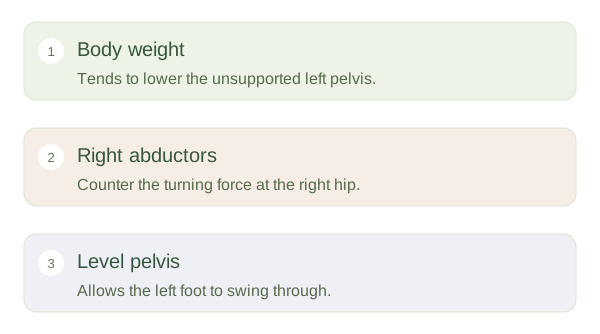
During a normal step, one foot supports the body while the other swings forward. Body weight tends to make the unsupported side of the pelvis drop. Gluteus medius and minimus on the standing side generate an opposing turning force. Think of the pelvis as a short beam balanced over one hip: body weight pulls one side down, while the abductors pull from the other side. The standing hip therefore experiences forces from both body weight and muscular effort, not body weight alone.
Control depends on nerves too
The superior gluteal nerve supplies gluteus medius and minimus, as well as tensor fasciae latae. Weakness in this system can produce a pelvic drop on the unsupported side, often called a . A person may lean the trunk towards the standing hip to reduce the demand on the abductors. This observation suggests a mechanism but does not identify one cause by itself; pain, joint changes and nerve problems can all affect control. Gluteus maximus receives a different nerve, the inferior gluteal nerve. Distinguishing extension from pelvic stabilisation helps explain why these muscles are not interchangeable.