Thigh and hip pathways
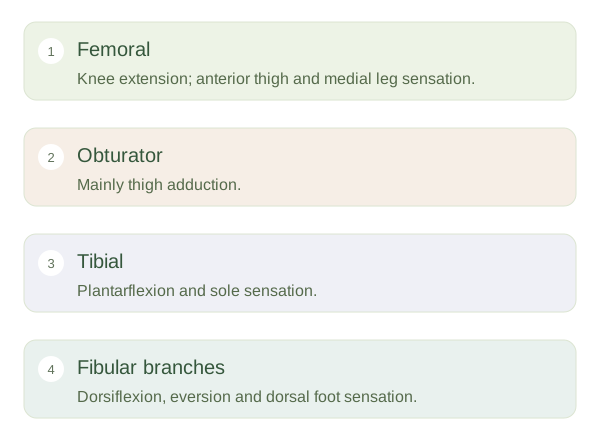
The femoral nerve supplies the quadriceps and other anterior thigh muscles, enabling knee extension. Sensory branches supply the anterior thigh, and its saphenous branch continues to the medial leg and foot. The obturator nerve mainly serves the medial thigh adductors, with a smaller and variable sensory area. Gluteal nerves control important hip muscles. These pathways illustrate a useful rule: a named nerve carries several types of fibres, so its injury may change movement and sensation together, although the exact findings depend on the location of the lesion.
Lower-limb nerve territories
 Open diagram larger ↗
Sciatic branches below the knee
The sciatic nerve contains tibial and common fibular divisions. The tibial nerve supplies posterior leg muscles and continues into serving much of the sole. The passes near the fibular neck, a relatively exposed location, before dividing. Its deep branch supplies anterior leg muscles, while its superficial branch supplies lateral leg muscles. Much of the top of the foot receives superficial fibular sensation; the small first web space receives deep fibular sensation. The sole is mainly supplied by tibial branches.
Reading patterns carefully
Weak dorsiflexion and eversion with altered sensation over the top of the foot can suggest common fibular involvement. However, similar movement problems may arise from a more proximal nerve or spinal-root problem. Testing additional muscles and sensory areas helps refine the map. Cutaneous territories overlap, and injuries can be partial, so a single numb patch is not a complete diagnosis. Compare the nerve territory with a dermatome: the first names a travelling peripheral pathway, while the second organises sensory supply by spinal level. Both maps are useful, but they answer different questions.