Making a difference easier to see
A changes how a structure appears so that a particular anatomical or functional question becomes easier to answer. It does not create a new organ or repair the underlying problem. An injected agent can help distinguish blood vessels from surrounding tissue or reveal how blood reaches an organ. An oral agent may outline parts of the digestive tract. Whether contrast is useful depends on the imaging method, the target and the timing. Some questions are answered well without it.
Different agents, different signals
 Open diagram larger ↗
Different physics, different materials
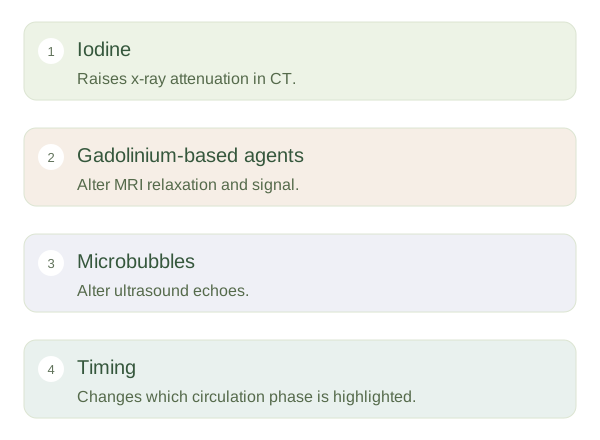
Iodine-containing agents increase x-ray attenuation and are widely used with CT and angiography. Barium preparations can outline the digestive tract in selected x-ray studies. Gadolinium-based MRI agents alter local relaxation properties rather than blocking x-rays. Ultrasound contrast uses tiny gas-filled microbubbles that influence returning echoes. These materials are not interchangeable. After an injection, early images may emphasise arteries, later images organs or veins, and still later images urinary excretion. The selected phase can change what is visible without any change in the patient’s anatomy.
Benefits require individual checks
Contrast agents are medicines and can have unwanted effects. Reactions are possible, while kidney function and other factors matter for particular agents and circumstances. A previous reaction needs its actual agent and features considered; the word contrast alone does not identify a single substance. Screening and appropriate selection reduce avoidable risk. Retained contrast or a bright vessel on an image also does not establish disease by itself. The main principle is targeted visibility: clinicians choose a substance whose physical behaviour makes the required difference measurable, then interpret the resulting pattern using the correct method and acquisition phase.