A test changes confidence
Medical tests provide evidence, but a positive result does not always mean disease is definitely present. A true positive correctly identifies disease, while a suggests it when it is absent. A false negative misses disease that is present. Biological variation, sampling, timing and test design can affect results. Some tests measure a continuous value that is compared with a threshold, so moving the threshold can change the balance between missed cases and false alarms. A boundary on a report is therefore not a complete diagnosis.
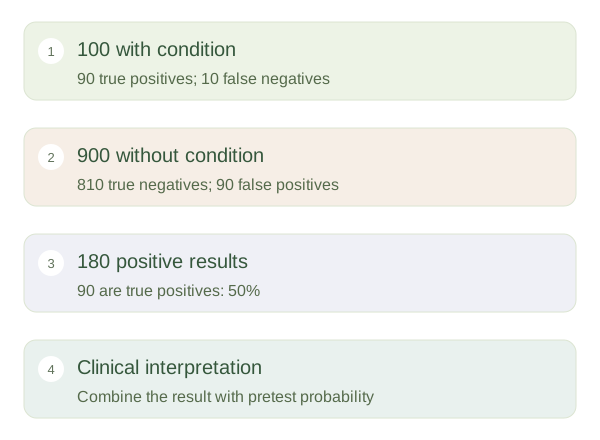
A 90%-sensitive, 90%-specific test in 1,000 people
 Open diagram larger ↗
Sensitivity and specificity answer different questions
asks what proportion of people with the condition receive a positive result. asks what proportion without it receive a negative result. These are different from the probability of disease after a positive result. Imagine 1,000 people, of whom 100 have a condition. A test with 90% sensitivity detects 90 of those 100. If specificity is also 90%, it falsely labels 90 of the 900 unaffected people positive. There are 180 positive results, but only 90 are true positives: half, not 90%.
Context supplies the starting point
The chance of disease before testing depends on the population, symptoms, history and other findings. When disease is uncommon, false positives can form a larger share of positive results. When clinical suspicion is high, one negative result may not settle the question. Further testing or observation may be needed, depending on the consequences and the test. Reference ranges also vary between laboratories and circumstances. The goal is not to distrust tests, but to ask what question a result answers and how much it changes the existing evidence. More testing is not automatically more certainty if the results are interpreted without context.