Reactions need a starting push
Chemical reactions rearrange atoms by breaking and forming bonds. Even an energy-releasing reaction usually needs an initial input called . Think of pushing a ball over a small ridge before it can roll downhill. At body temperature, many useful reactions would happen too slowly without assistance. Enzymes provide a pathway with a lower activation barrier. Most enzymes are proteins, although some RNA molecules also have catalytic activity. A catalyst speeds a reaction while being regenerated, so the same molecule can work repeatedly.
Enzymes and Chemical Reactions
 Open diagram larger ↗
A selective working site
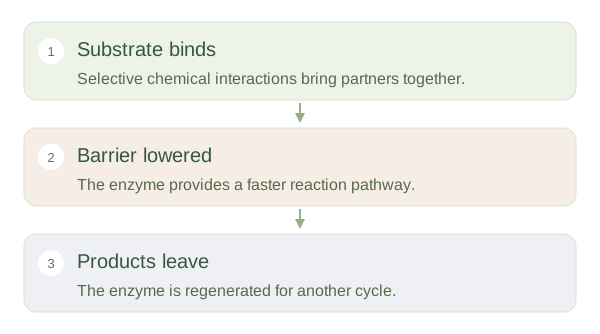
The reacting molecules, or substrates, bind at an enzyme’s . Its shape and chemical properties favour particular partners. The can position substrates, strain certain bonds or provide a helpful local chemical environment. The active site is flexible rather than a rigid keyhole: binding often changes the enzyme’s shape slightly. Products then leave, freeing the enzyme for another cycle. Because active sites are selective, cells need many different enzymes. Some require additional partners, such as metal ions or molecules derived from vitamins, to function properly.
Speed is regulated
activity depends on temperature, pH, availability and regulatory signals. Extreme conditions can alter protein structure, reducing activity. Increasing substrate can accelerate a reaction only until the available enzymes are working near capacity. Cells also use inhibitors and feedback to avoid making more product than they need. An enzyme does not make an energetically impossible reaction possible by itself: energy-demanding reactions are often coupled to energy-releasing processes such as ATP breakdown. Catalysis changes how quickly equilibrium is approached, not the final equilibrium itself. This distinction separates reaction speed from the overall energy balance of a cell.