A useful boundary
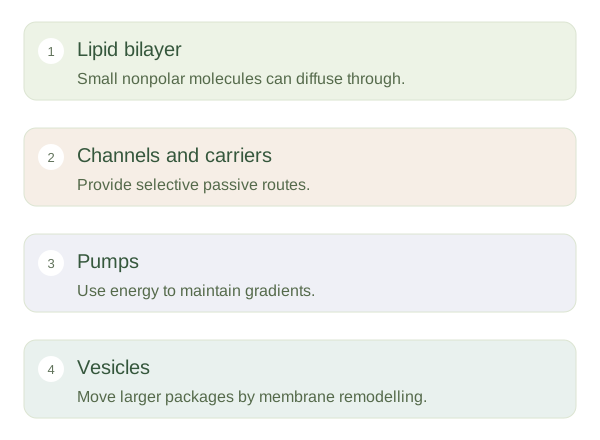
Every cell has a plasma membrane separating its interior from surrounding fluid. Its main framework is a phospholipid bilayer containing proteins, cholesterol and carbohydrate groups. This flexible boundary allows communication and controlled exchange rather than sealing the cell completely. Small nonpolar molecules, including oxygen and carbon dioxide, cross the lipid region relatively readily. Charged particles and many larger or water-soluble molecules need specialised pathways. means substances cross at different rates depending on their properties and the transport mechanisms available to that particular cell.
Cell Membranes and Transport
 Open diagram larger ↗
Moving down a gradient
is net movement from higher towards lower concentration, produced by the random motion of particles. It does not require direct cellular energy input. Channels allow certain ions or water through, while carrier proteins bind a substance and change shape to move it across. Such facilitated diffusion still follows the relevant gradient. describes net water movement across a selectively permeable membrane towards a region with a higher effective concentration of nonpenetrating solutes. This can change cell volume, explaining why the composition of surrounding fluid matters.
Moving against the trend
can move substances against their electrochemical gradients. The sodium–potassium pump uses ATP to export sodium and import potassium, helping maintain different ion concentrations across the membrane. Other transporters use an existing ion gradient as an indirect energy source. For larger packages, cells can bring material in by endocytosis or release it by exocytosis. The membrane therefore behaves less like a simple sieve and more like a regulated border. Different transport proteins give intestinal, kidney and nerve cells different capabilities even though all share the same basic bilayer design.