Energy is transferred
Cells need energy to build molecules, move materials and maintain internal conditions. They do not create energy from nothing. Instead, they transfer energy from nutrients into forms that support particular tasks. , adenosine triphosphate, acts as a rapidly recycled energy carrier. Coupling ATP breakdown to another process can drive that process forward. ATP stores are small compared with the energy needed over a day, so cells continually regenerate it. Food reserves are more like a fuel supply, while ATP is a short-lived working currency.
How Cells Obtain Energy
 Open diagram larger ↗
From glucose to ATP
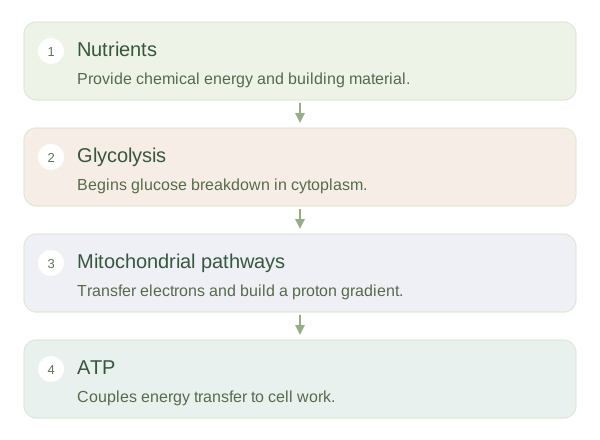
starts glucose breakdown in the cytoplasm, producing pyruvate and a small amount of . When conditions allow, mitochondria process fuel further through the citric acid cycle and an electron transport chain. Electrons pass through proteins that help create a proton gradient across the inner mitochondrial membrane. uses that gradient to produce ATP. Oxygen accepts electrons at the end of the chain and contributes to water formation. Carbon dioxide is produced during other stages of fuel breakdown and is eventually carried to the lungs.
Different fuels and circumstances
Fatty acids and some amino acids can also feed into energy pathways. When oxygen delivery or mitochondrial capacity cannot match demand, can still supply some , with pyruvate converted to lactate to regenerate a necessary chemical partner. Lactate is not merely useless waste: other tissues can use it as fuel or as material for making glucose. Cells differ in their energy machinery; mature red blood cells lack mitochondria and depend on glycolysis. Understanding this variety explains why adequate circulation, oxygen delivery and nutrients all matter, yet no single pathway supplies every cell in exactly the same way.