Instructions within cells
DNA stores biological information in a sequence of chemical bases. In most human cells, most DNA is packaged into chromosomes inside the nucleus; mitochondria contain a small additional genome. A is a DNA region whose information contributes to a functional product, often a protein. Cells do not use every gene equally. Regulatory signals help determine which genes are active, allowing a nerve cell and a muscle cell to behave differently despite carrying largely the same genetic information. DNA is therefore an instruction resource rather than a fixed script for every moment.
Genes, Proteins and Inheritance
 Open diagram larger ↗
From gene to protein
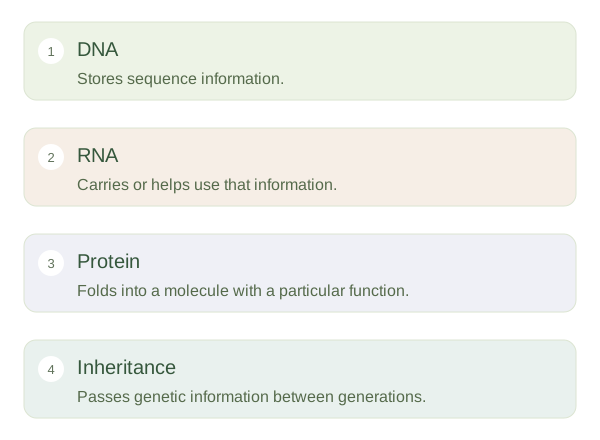
For a protein-coding , a working RNA copy is produced through . Ribosomes read messenger RNA during and join amino acids in the specified order. The resulting chain folds and may be modified before it performs its job. A sequence change, called a variant, can have no noticeable effect, alter function or disrupt production. Effects depend on the change and its context. Many characteristics involve numerous genes and environmental influences, so a single gene rarely explains a complex trait on its own.
Passing information onward
Most body cells usually contain 23 chromosome pairs, with one member of each pair inherited from each biological parent. Egg and sperm formation reduces the chromosome number so fertilisation restores the paired set. Different versions of a are called alleles. In a simple recessive inheritance pattern, one working copy may provide enough function to prevent disease; dominant patterns can show an effect with one altered copy. These are useful models, not rules for every condition. New variants, mitochondrial inheritance and chromosome changes provide other routes. Genetic information influences probabilities and mechanisms, but it does not make every outcome inevitable.