From cells to tissues
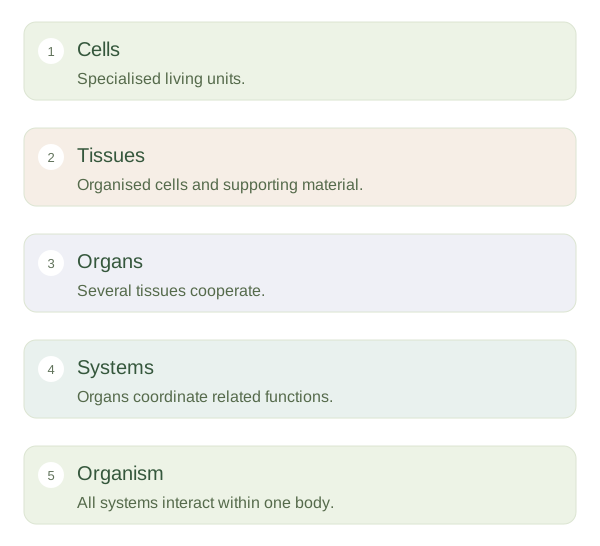
A is the smallest living unit of the body. Cells share basic machinery but specialise in different tasks: a neuron transmits signals, while a red blood cell carries oxygen. A combines cells and the surrounding material into a functional arrangement. The four broad tissue types are epithelial, connective, muscle and nervous tissue. Epithelium covers surfaces and forms glands; connective tissue supports and links structures; muscle produces force; nervous tissue processes and carries information. These categories describe useful patterns rather than four isolated populations that never interact.
Cells, Tissues, Organs and Systems
 Open diagram larger ↗
Organs combine tissue types
An is a recognisable structure containing multiple types working together. The stomach, for example, has an epithelial lining that secretes and protects, connective tissue that supports vessels and cells, muscle layers that mix contents, and nerves that coordinate activity. Calling the stomach simply a muscular bag misses much of what makes it function. Its shape, layered wall, blood supply and communication with other organs all matter. Damage to one component can disturb the organ even if its remaining components are initially intact.
Systems work across boundaries
An is a group of organs with related functions, such as digestion or circulation. These labels help learning but do not divide the body into independent machines. The lungs exchange gases, the cardiovascular system transports them, and the nervous system helps regulate breathing. The endocrine pancreas contributes to hormonal control while another part of the same supplies digestive enzymes. A system can therefore share organs or depend on structures studied elsewhere. When learning a new topic, ask both what its smaller parts do and how it supports the larger whole. This makes names meaningful and prepares you to understand why illness in one organ can affect several others.