Stability is an active process
Your surroundings change, meals arrive irregularly and muscles use different amounts of energy, yet cells need reasonably stable conditions. is the regulation that keeps internal variables within suitable ranges. These variables include temperature, blood glucose and aspects of fluid composition. Stability does not mean a perfectly unchanging number: values fluctuate with activity, time of day and other circumstances. A regulated range is more like maintaining a comfortable room temperature than freezing the room at a mathematically exact value. The body continually measures conditions and adjusts its responses.
Homeostasis and Feedback
 Open diagram larger ↗
Negative feedback opposes change
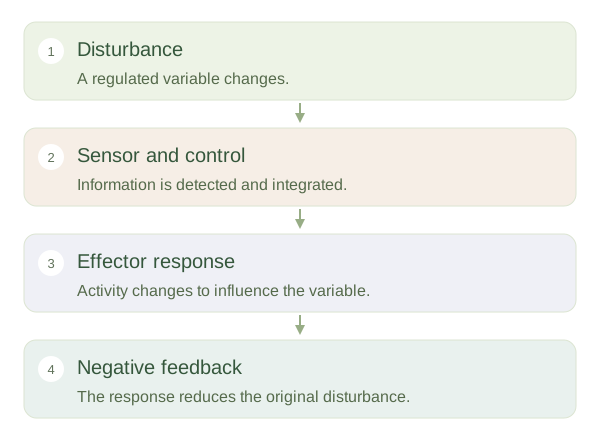
A typical control loop includes a sensor, a control centre and an . Sensors detect a variable; the control centre compares information with a desired condition; effectors change their activity. If body temperature rises, responses such as increased skin blood flow and sweating can increase heat loss. As temperature moves back towards its range, the driving signal decreases. This is because the response opposes the original disturbance. The word negative describes the relationship, not a harmful effect. Many overlapping loops cooperate rather than relying on one simple thermostat.
Positive feedback amplifies change
reinforces a developing process until an external limit or endpoint stops it. During childbirth, cervical stretch can promote oxytocin release, which strengthens contractions and produces more stretch. Delivery removes the stimulus. Positive feedback is useful when a process needs to move decisively towards completion, but uncontrolled amplification can be dangerous. Not every bodily response is homeostatic, and a response can maintain one variable at a cost to another. Understanding the loop requires identifying what is sensed, what changes and how the response affects the initial stimulus. This is more useful than memorising the words positive and negative.