Two main compartments
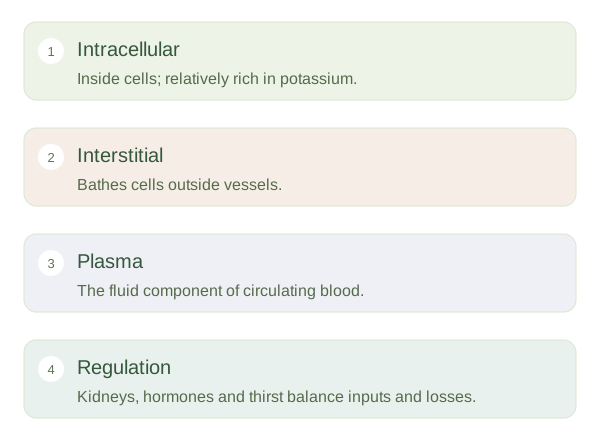
Body water is divided between , inside cells, and , outside them. Extracellular fluid includes plasma within blood vessels and between tissue cells. Water and many small substances move between these compartments, but membranes and vessel walls regulate the exchange. Plasma proteins are largely retained within healthy vessels, while cell membranes maintain major differences in ion concentrations. These differences are essential: simply having enough total water does not guarantee that water and dissolved substances are distributed appropriately between compartments.
Body Fluids and Electrolytes
 Open diagram larger ↗
Composition matters
Sodium is the main positive ion in , whereas potassium is concentrated inside cells. Both support electrical activity, but their concentrations must remain controlled. Water movement responds to effective solute differences across membranes, so changes in extracellular concentration can make cells swell or shrink. The brain is particularly sensitive to large disturbances because it is enclosed by the skull and depends on stable electrical signalling. Electrolyte balance is therefore not just about replacing water after sweating; it concerns the relationships among water, dissolved particles and transport across boundaries.
Balancing inputs and outputs
Water enters through drinks, food and metabolic reactions. It leaves through urine, breathing, skin and faeces. The kidneys adjust how much water and salt they retain, guided by hormones and circulation. Thirst helps influence intake. promotes water conservation when appropriate, while other signals regulate sodium handling and blood volume. These mechanisms interact: a person can have excess fluid in tissues while circulation still provides an inadequate effective blood supply. A useful learning habit is to ask three questions separately: how much fluid is present, where is it located, and what is dissolved in it? Each can change independently and produce different consequences.