A living framework
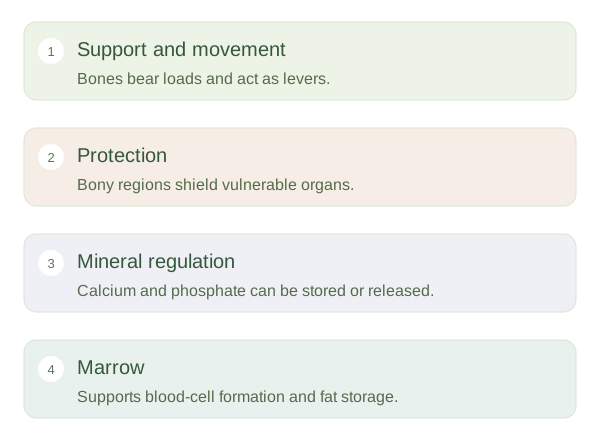
Bones support the body and provide a framework for movement. Their rigidity helps maintain shape against gravity, while muscles pull on them across joints to move different regions. A bone is therefore both a supporting structure and part of a lever system. The skull protects the brain, vertebrae surround the spinal cord and the rib cage helps protect the heart and lungs. Protection is balanced with other needs: the thorax must remain able to expand during breathing, and the limbs need mobility as well as strength.
What Bones Do
 Open diagram larger ↗
More than mineral rods
Bone is living tissue supplied by blood vessels and nerves. Its extracellular matrix contains collagen fibres and mineral crystals. Collagen contributes resistance to stretching, while mineral provides hardness and resistance to compression. This combination allows useful strength without making the skeleton a set of completely brittle stone rods. Cells continually maintain and remodel the matrix. The architecture varies with location and loading: dense outer bone and an internal network of trabeculae distribute forces while avoiding the weight of a completely solid structure.
Chemical and cellular roles
The skeleton stores much of the body’s calcium and . Hormonal regulation helps coordinate exchange between bone and extracellular fluid, supporting functions such as muscle contraction and cell signalling. Red bone marrow produces blood cells, including oxygen-carrying red cells, many immune cells and the precursors of platelets. Yellow marrow contains a larger proportion of fat and contributes an energy reserve. Marrow distribution changes with age and varies among bones. These roles connect skeletal health with circulation, immunity and chemical balance. Understanding bone as an active organ explains why changes in nutrition, hormones, blood supply or mechanical use can affect the skeleton over time.