Building and lengthening bone
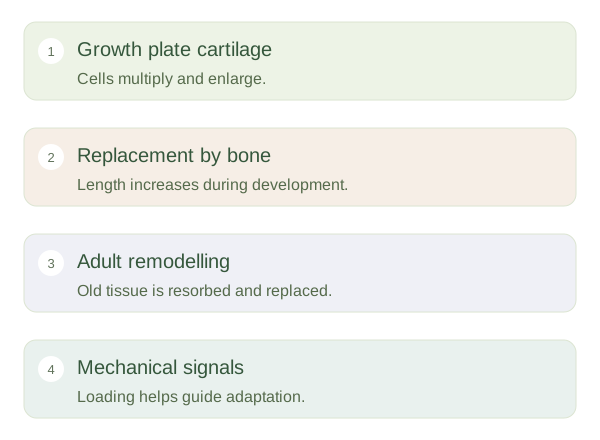
Bone develops by two main routes. Some bones form directly within connective tissue, while many develop by replacing a cartilage model. This second route is called endochondral . In a growing long bone, a of cartilage remains between the shaft and each end. Cartilage cells multiply and enlarge, while cartilage nearer the shaft is replaced by bone. This coordinated process lengthens the bone. It is not the mature mineralised shaft stretching like rubber. Once growth plates close, normal lengthening at those sites stops.
Bone Growth and Remodelling
 Open diagram larger ↗
Width and strength can change
Bones can grow in width as cells add tissue at the outer surface while internal surfaces are adjusted. Throughout life, replaces small regions of old bone with new bone. Osteoclasts remove matrix and osteoblasts build replacement matrix. Osteocytes embedded in the bone help detect mechanical conditions and coordinate responses. Loading influences where tissue is needed, so repeated forces can affect bone architecture. The response takes time and depends on adequate nutrition, hormonal conditions and recovery. More force is not always better: excessive or repeated loading can also cause injury.
Balancing removal and formation
Healthy repairs microscopic damage and contributes to mineral regulation. The amount removed and the amount formed are not always equal. If removal persistently exceeds formation, bone mass and architecture may deteriorate. Hormones, age, disuse and disease can shift this balance. Calcium and phosphate supply matter, but bone health cannot be reduced to one dietary ingredient: collagen production, blood supply, vitamin-related processes and mechanical use also contribute. The important distinction is between growth, which changes the developing skeleton’s size, and remodelling, which renews existing tissue. An adult bone can therefore remain biologically active even when the person has stopped growing taller.