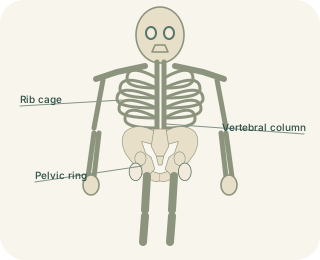
The central framework
The includes the skull, vertebral column and thoracic cage, along with associated bones such as the hyoid and small auditory ossicles. It supports the central body axis and protects the brain, spinal cord and thoracic organs. The vertebral column also transfers weight towards the pelvis, while the thoracic cage participates in breathing. These structures are not one immovable block. Joints between vertebrae permit controlled movement, and rib attachments allow the chest wall to change shape during ventilation. Protection and movement are therefore balanced within the same framework.
Axial and Appendicular Skeletons
 Open diagram larger ↗
Limbs and girdles
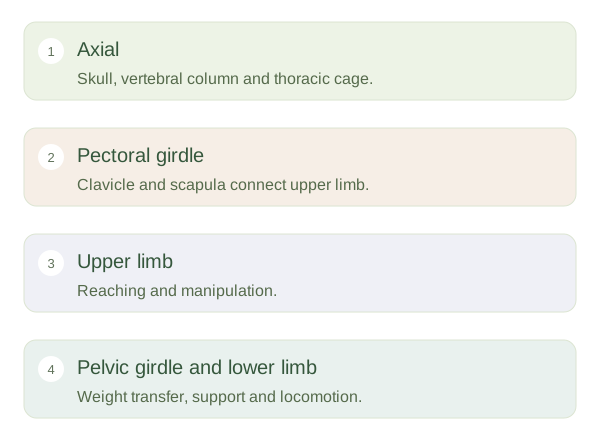
The includes the upper and lower limbs plus their supporting girdles. The contains the clavicles and scapulae, linking the upper limbs to the trunk. Its arrangement permits broad movement and positioning of the hands. The is formed by the hip bones, which connect the lower limbs to the through the sacrum. This arrangement prioritises weight transfer and stability alongside movement. The sacrum itself belongs to the axial skeleton, even though it forms part of the complete bony pelvis.
Classification helps explain function
A limb contains long bones that act as levers, smaller bones that distribute forces and joints that guide movement. The upper limb is particularly suited to reaching and manipulation, while the lower limb supports standing and locomotion. These are broad functional patterns rather than absolute limits. Classification is useful because it relates regions to their jobs: a spinal injury concerns the axial framework, while a wrist injury concerns an appendicular structure. Remember that an adult bone count is an approximate standard, not a perfect identifier for every individual; fusion and accessory bones create normal variation. The two divisions cooperate continuously whenever you stand, breathe or reach.