ATP must be renewed
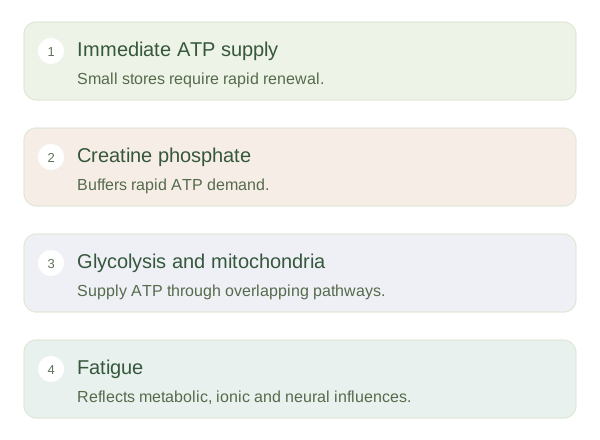
Contracting muscle uses ATP for cross-bridge cycling, ion pumping and calcium handling. Stored ATP supports only a brief period of substantial activity, so fibres continually regenerate it. can transfer a phosphate to ADP to replenish ATP rapidly. supplies ATP through glucose breakdown, while mitochondrial pathways use oxygen and a variety of fuels to support longer activity. These systems overlap from the start rather than taking turns as completely separate switches. Their relative contributions change with exercise intensity, duration and the fibre’s capabilities.
Muscle Energy and Fatigue
 Open diagram larger ↗
Demand and supply can diverge
During intense activity, ATP demand rises quickly. can increase rapidly, while oxygen delivery and mitochondrial processing may not match the required rate. formation helps regenerate a partner needed for glycolysis to continue. Lactate can later be used by other tissues and is not simply a toxin responsible for every sensation of . Muscle performance also depends on fuel availability, temperature, ion distributions and calcium release. A long endurance task and a short maximal effort can therefore limit performance through different combinations of mechanisms.
Fatigue is a whole-system result
means a reduced ability to produce the expected force or performance. It can involve changes within the muscle and changes in neural drive. Protective regulation, discomfort, motivation and the task itself influence the outcome. Normal fatigue does not usually mean ATP has fallen to zero; that would threaten essential cellular functions. Recovery restores chemical conditions and replenishes resources at different rates. Delayed muscle soreness after unfamiliar activity is also distinct from the immediate mechanisms limiting performance during exercise. The useful model is a supply-and-control network: working fibres need energy, suitable ions, calcium cycling and nervous coordination, all supported by circulation and respiration.