Pulling in different directions
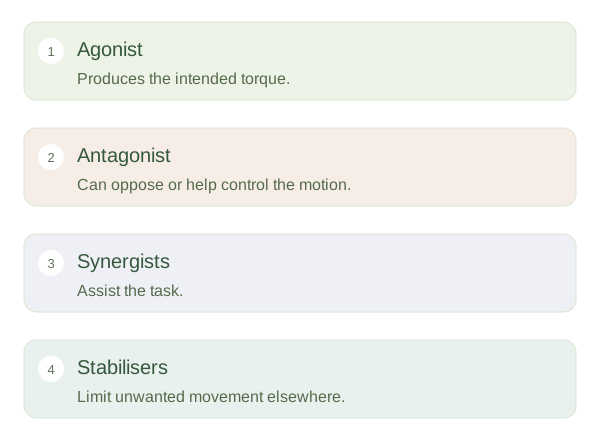
A muscle normally generates tensile force: it pulls through its attachments rather than pushing a bone directly. To move a joint in opposite directions, the body therefore uses muscles with different lines of pull. An contributes strongly to the intended action, while an can produce an opposing action. During elbow flexion, the biceps brachii can contribute as a flexor and the triceps brachii can oppose extension. These roles are task-dependent, not permanent moral labels: the same muscle may become an agonist when the direction of the task changes.
How Opposing Muscles Work Together
 Open diagram larger ↗
Coordination is not simple switching
Antagonists do not always become completely inactive when an works. Co-contraction can increase joint stiffness and help control alignment, especially during an unfamiliar or demanding task. Synergists assist an action, while stabilisers limit unwanted movement elsewhere. For example, reaching with the hand requires the shoulder girdle and trunk to provide a suitable base. A named muscle can also perform several actions because it crosses joints or has a line of pull that changes with position. Studying isolated actions is a starting point, not a complete description of movement.
Lowering also uses muscle
When lowering an object slowly, a muscle may remain active while lengthening. This controls the movement rather than merely allowing the limb to fall. When it shortens while active, the action is concentric; when overall length remains nearly constant, it is isometric. These descriptions concern the relationship between force and movement, not whether the muscle receives a signal. Coordinated activity depends on sensory feedback and prediction as the nervous system adjusts to changing loads. Instead of memorising a single muscle for each movement, consider the team: which muscles create the intended torque, which control the speed and which stabilise neighbouring joints?