Connecting muscle to skeleton
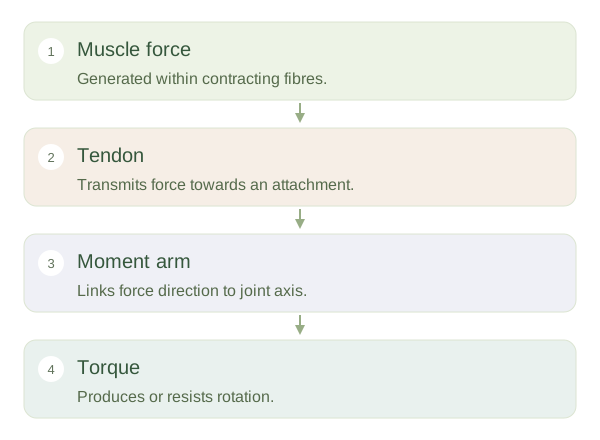
A transmits muscle force to an attachment, usually on bone. Its collagen-rich structure is strong in tension, and its fibres connect with the muscle’s surrounding connective tissues. Some muscles have broad sheet-like attachments called aponeuroses. Tendons are not miniature muscles: they do not actively shorten by cross-bridge cycling. However, they can stretch and recoil, temporarily storing elastic energy during movement. Their properties influence how muscle force is delivered, particularly during activities such as walking and running. Force transmission therefore involves a connected mechanical chain.
Tendons, Levers and Joint Movement
 Open diagram larger ↗
Bones act as levers
At a joint, a bone can rotate around an axis. A muscle’s pull creates , a turning effect equal to force multiplied by its perpendicular . The moment arm is the shortest perpendicular distance from the joint axis to the force’s line of action. A larger moment arm can produce more torque for the same force, although geometry changes as the joint moves. External loads also create torque. Holding an object farther from the elbow increases its turning effect, even when the object’s weight stays unchanged.
Trade-offs shape movement
Many limb muscles attach close to a joint compared with the location of an external load. This arrangement often requires substantial muscle force but permits useful movement speed and range at the hand or foot. It is not a poorly designed lever simply because it lacks a large force advantage. Muscle force, joint position and path all influence the movement produced. A muscle can also generate while the joint remains still because opposing torques balance. Understanding levers helps connect an anatomical attachment to its mechanical consequence: ask where the axis lies, where the tendon pulls and how far the load acts from the axis.