A neuron and its fibres
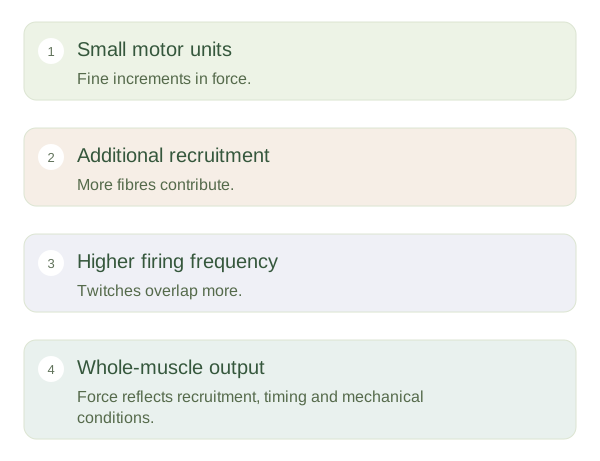
A consists of one motor neuron and all the skeletal muscle fibres it supplies. When that neuron sends an action potential down its branches, its fibres are normally activated together. Small motor units allow fine adjustments, as in muscles controlling precise finger movements. Larger units can activate many fibres at once, supporting stronger, less finely graded force changes. Individual fibres respond electrically in an all-or-none manner when activated, but this does not mean a whole muscle can produce only one fixed amount of force.
Motor Units and Muscle Control
 Open diagram larger ↗
Recruitment grades the response
The nervous system increases force partly by recruiting additional motor units. During many ordinary tasks, smaller, lower-threshold units are recruited before larger, higher-threshold units. This size principle supports efficient progression from gentle activity to stronger effort. The exact pattern depends on the task and the muscle. Units can also share activity over time, helping sustain a posture without every fibre working maximally throughout. is coordinated with information about joint position, load and movement goals. More electrical activity is useful only when it produces an appropriately timed mechanical response.
Timing also changes tension
A single brief stimulation produces a . If another signal arrives before relaxation is complete, the resulting tensions can add, a process called . At sufficiently high stimulation frequencies, contractions become more sustained. Force also depends on muscle length, shortening velocity and fatigue, so and frequency are not the only influences. Everyday control combines these factors automatically. Picking up a feather and lifting a shopping bag may use the same muscle but different numbers of active units and different firing patterns. This explains how the body grades movement smoothly without requiring each fibre to invent a separate weak or strong electrical action potential.