Training changes more than size
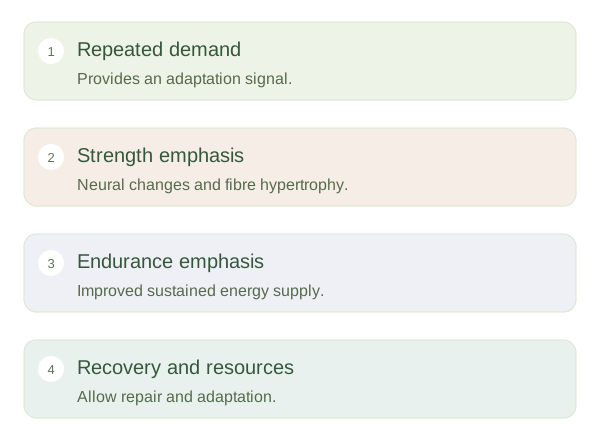
Repeated muscular activity can alter both the muscle and its control. Strength training often improves performance initially through neural adaptations, including more effective recruitment and coordination. With sufficient repeated stimulus and recovery, fibres can increase their protein content and cross-sectional size, called . This is mostly enlargement of existing fibres rather than production of large numbers of new ones. Tendons and other supporting tissues also adapt, but their time course may differ. A stronger performance is therefore not explained by one visual change in muscle size alone.
Strength, Endurance and Adaptation
 Open diagram larger ↗
Endurance favours sustained supply
activity encourages adaptations that help fibres repeatedly produce ATP over longer periods. These can include increased mitochondrial capacity, improved supply and changes in fuel handling. The cardiovascular and respiratory systems also contribute to overall endurance performance. Muscle fibres vary in contraction speed, metabolic properties and resistance to fatigue. Training can alter some properties, but it does not make all fibres identical or erase inherited influences. The adaptation is related to the demand: practising prolonged low-force work does not create exactly the same response as repeatedly producing high forces.
Use, recovery and loss
Adaptation depends on the interaction between load and recovery. Activity produces signals for change, while repair and protein turnover require adequate resources and time. Excessive demand without sufficient recovery can outpace capacity rather than improve it. Reduced use, immobilisation or some illnesses can cause , a decline in muscle size and capacity. Age also influences the response, but adaptation remains possible across life. These principles describe biological mechanisms rather than a personal exercise prescription. When comparing strength and , ask which limiting factor is being trained: force production, coordination, oxygen-supported energy supply or the ability to repeat a task.