Blood has a fluid and a cellular part
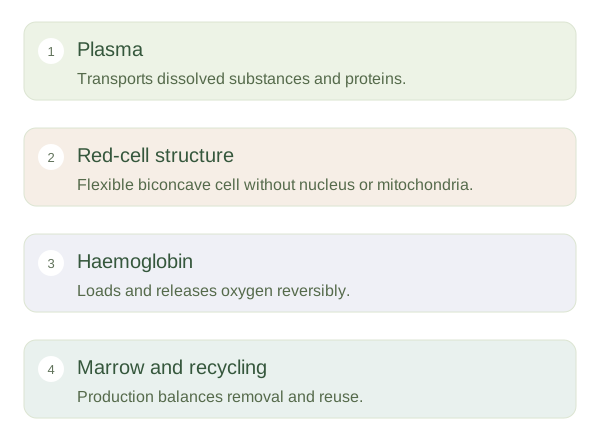
Blood is a circulating connective tissue. Its fluid component, , is mostly water containing proteins, ions, nutrients, hormones and metabolic products. Albumin helps maintain plasma’s protein-related oncotic effect and transports some substances. Other proteins contribute to immunity or clotting. Plasma is not the same as serum: serum is the fluid remaining after clotting, with fibrinogen and some other clotting components removed or altered. The cellular elements suspended in plasma include red cells, white cells and platelets, each with different roles.
Plasma and Red Blood Cells
 Open diagram larger ↗
Red cells suit gas transport
Red blood cells, or erythrocytes, are flexible biconcave discs. Their shape provides a large surface relative to volume and allows deformation through narrow vessels. Mature human red cells lack a nucleus and mitochondria, leaving space for and preventing them from consuming oxygen through mitochondrial respiration. Haemoglobin reversibly binds oxygen, allowing loading in the lungs and release where tissue conditions favour unloading. Red cells also participate in carbon dioxide transport and acid–base buffering. Their function therefore involves more than passively carrying a fixed amount of oxygen everywhere.
Production and turnover
Red cells are produced in red bone marrow. When oxygen delivery is inadequate, the kidneys can increase erythropoietin signalling, stimulating red-cell production. Making functional cells requires resources including iron, amino acids and relevant vitamins. Old or damaged cells are removed, particularly through the spleen and liver, and useful components are recycled. describes the proportion of blood volume occupied by red cells; it is not the same measurement as concentration. Oxygen delivery depends on haemoglobin, its saturation and blood flow, so a normal-looking oxygen saturation reading alone cannot establish that tissue delivery is adequate in every circumstance.