Two deliveries must cooperate
brings fresh air to alveoli. brings blood through their surrounding capillaries. Both are needed for useful gas exchange. Imagine a railway station: passengers and trains must arrive at the same platform. A well-ventilated alveolus contributes little oxygen to the body if almost no blood reaches it. A well-perfused alveolus also performs poorly if its air is not refreshed. The balance is called ventilation–perfusion matching, often shortened to V/Q matching.
Gas exchange needs air and blood to meet in the same place.
 Open diagram larger ↗
Different kinds of mismatch
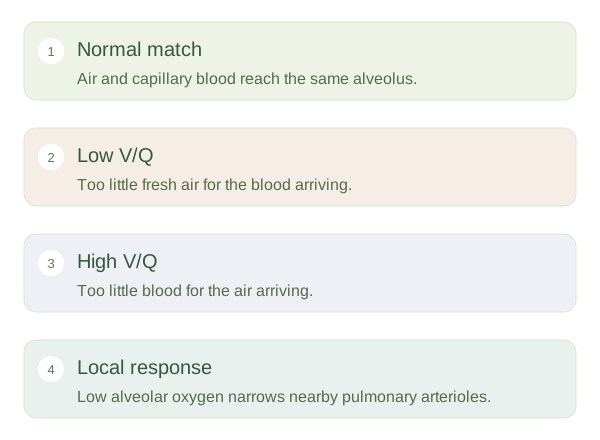
When falls but blood flow continues, the local is low. Blood leaves that region with less oxygen than expected. A completely unventilated but perfused region behaves like a . When blood flow falls but ventilation continues, the ratio is high. Some ventilation is wasted because little blood is available to collect oxygen. A pulmonary embolus can create this pattern by obstructing a branch of the pulmonary circulation. Neither pattern is the same as a problem with oxygen crossing an unusually thick respiratory membrane.
Matching is active and imperfect
Gravity affects both air and blood distribution, so even healthy lungs are not uniform from top to bottom. Local control improves the overall match. In particular, low alveolar oxygen tends to constrict nearby small pulmonary arteries, redirecting some blood towards better-ventilated areas. This response differs from many systemic tissues, where low oxygen usually encourages greater blood delivery. The response helps when a limited lung region is affected, but widespread low oxygen can increase pressure in the pulmonary circulation. Understanding mismatch explains why moving plenty of air does not always guarantee good oxygenation. The important question is whether fresh air and flowing blood can meet at an effective exchange surface throughout enough of the lung.