Oxygen needs a carrier
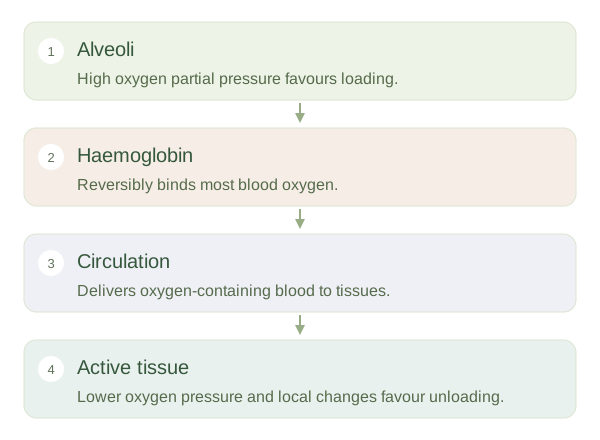
A small amount of oxygen dissolves directly in blood plasma, but this alone cannot meet ordinary tissue needs. Most oxygen travels attached to inside red blood cells. Each haemoglobin molecule can bind several oxygen molecules reversibly. In the lungs, a high oxygen partial pressure favours loading. In tissues, lower oxygen partial pressure favours release. Oxygen is not permanently glued to its carrier: reversible binding is what makes transport useful.
Haemoglobin carries most oxygen, but delivery also needs blood flow.
 Open diagram larger ↗
Loading and unloading are cooperative
changes its as oxygen molecules bind. This produces a curved relationship between oxygen partial pressure and haemoglobin , rather than a simple straight line. At the high pressures found in healthy lungs, saturation remains high across a useful range. In working tissues, relatively small falls in oxygen pressure can release a larger share of the carried oxygen. Increased temperature, carbon dioxide and acidity generally encourage unloading. These changes often occur in active tissues, helping match delivery to demand.
Saturation is only part of the story
A pulse oximeter estimates the percentage of available binding sites occupied by oxygen. It does not directly measure the amount of haemoglobin present or the adequacy of circulation. Someone with may have a normal but carry less total oxygen because there is less haemoglobin. Likewise, well-oxygenated blood cannot support a tissue effectively if blood flow is critically reduced. Overall delivery depends on oxygen content multiplied by blood flow. This is why lungs, red blood cells and the heart function as a transport partnership. Thinking in terms of both cargo and delivery vehicles is more useful than assuming one oxygen reading describes the entire system. Haemoglobin must load oxygen, blood must carry it and tissues must be able to use it.